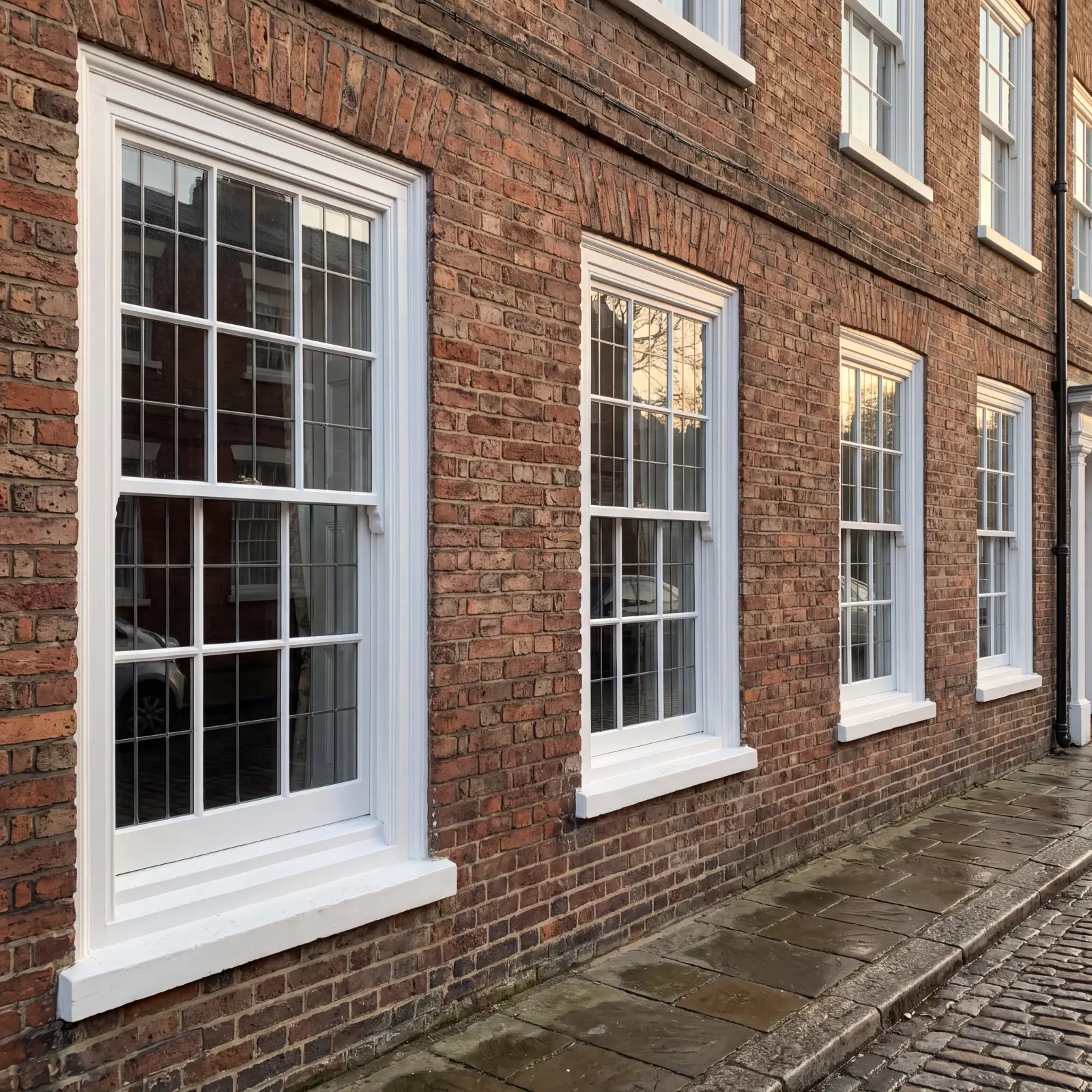
No window carries more architectural affection than the box sash. The tall, counterweighted slider defined British elevations from the Georgians right through to the Edwardians. And no window generates more domestic complaint. The rattle. The draughts. The single glazing, the annual repainting, the sash that either won't open or won't stay open. Modern vertical sliders exist to resolve exactly that tension, and they've become good enough that anyone nursing original sashes through another winter owes the question a fresh look. We build them, so we're biased, but we'll show our working.
What a modern vertical slider actually is
In operation it's a sash window, two sashes sliding vertically past each other, rebuilt with modern internals. uPVC or aluminium construction, spring or spiral balances instead of cords and cast-iron weights, brush seals in every channel, double glazed units with warm edges, and multi-point locking. The best of them tilt inward for cleaning. What the street sees is proportion and detail, meaning deep bottom rails, slim meeting bars, run-through sash horns and period glazing bars in the right places. What you feel, living behind them, is the absence of everything you used to complain about.
The look: what separates convincing from clumsy
- Proportions. Original sashes are tall and slim with a distinctive rail hierarchy. Replacements that squash the pattern shout 'plastic' from across the road.
- Sash horns. Those little downward extensions on the upper sash. Run-through horns, moulded as part of the sash, read as authentic. Clipped-on ones read as an apology.
- Glazing bars. Mechanically bonded or integral bars with period spacing, matched to the street. Never flat stick-ons.
- Colour and finish. Whites, creams and heritage shades in smooth finishes carry the painted-timber illusion, and the same rules as flush casements apply here too.
The performance jump, quantified
An original single-glazed sash loses heat at a U-value around 4.8-5.0, with air leakage through every channel on top of that. A quality modern slider achieves 1.3-1.4 with brush seals throughout, roughly 70% less heat loss before you even count the draughts eliminated. You feel the difference within days. Rooms hold their temperature, the morning condensation ritual ends, and street noise softens noticeably. On heating bills, sash-heavy period houses see some of the biggest percentage savings of any replacement type, simply because the starting point is so poor.
Replace, or restore the originals?
Both are legitimate, and we say that as a firm that profits from only one of them. Sound original timber deserves proper consideration. An overhaul with routed-in draught-proofing transforms rattly sashes for a fraction of replacement cost, and slim double-glazed or vacuum units can sometimes go into original frames. The full decision tree lives in our Victorian windows guide. Replacement earns its place when rot has reached the joints and frames, when the boxes themselves are failing, or when your performance ambitions exceed what restoration can deliver. Listed buildings almost always mean restoration or like-for-like timber, with consent. For the unlisted majority of Manchester's period stock, the modern slider is the pragmatic sweet spot.
Conservation areas: designed to pass
On ordinary streets, sympathetic sliders need no permission at all. In conservation areas, and the Article 4 pockets across Didsbury, Chorlton, Heaton Moor and similar, applications succeed on detail. Correct proportions, authentic bars, appropriate colours, and specification sheets that show the planner exactly what the street will see. We supply application-ready drawings with our heritage range, and the planning guide walks you through the process. Across Greater Manchester the approval pattern is remarkably consistent: well-detailed uPVC and aluminium sliders pass routinely where generic casements never would.
Costs and expectations
Made-to-measure uPVC vertical sliders run £900-£1,500 per window fitted. Aluminium and oversized openings cost more, and bays get priced as the structural jobs they are. That's roughly double a standard casement, because the mechanism, balances and detailing genuinely are more complex, and it buys the only replacement style that belongs on a period elevation. A whole-house heritage replacement on a Manchester terrace typically lands between £7,000 and £12,000, fabricated to measure in Trafford Park with PAS 24 locking, tilt-in cleaning and a 10-year guarantee. From the pavement, it reads as the house finally getting its windows back.
Living with them: the small daily differences
Owners who've switched from originals tell us the same things, almost word for word. Sashes that glide on balances and stay exactly where you put them, with no props, no slammed guillotine moments, and no worries in a child's bedroom. Both sashes opening properly restores the old Victorian ventilation trick, top sash down and bottom sash up, which circulates a room beautifully, and the locked night-vent positions do it securely. Cleaning becomes a tilt rather than a ladder. And deep winter changes character altogether. The bay that used to be the coldest spot in the house becomes merely a seat with a view. None of that appears on a specification sheet, and all of it is why heritage sliders are the replacement we get thanked for most.
Frequently asked questions
How much does sash window replacement cost?
Quality uPVC vertical sliders run £900-£1,500 per window fitted in 2026, with aluminium and large or bay openings above that. It's roughly double a standard casement, because the sliding mechanism and heritage detailing are more complex, and it's a style premium period houses tend to repay at sale.
Do uPVC sash windows look convincing?
The good ones genuinely do. Run-through horns, correct rail proportions, bonded glazing bars and heritage colours pass casual and planning scrutiny alike. The unconvincing ones miss on exactly those details, so judge suppliers by them.
Can I keep my original sash windows and stop the draughts?
Often, yes. An overhaul with routed brush-seal draught-proofing transforms sound originals at modest cost, and slim double glazing sometimes fits into original sashes. Rot in the joints, frames or boxes is the point where replacement becomes the better spend.
Are modern sash windows allowed in conservation areas?
Frequently, with sympathetic detailing. Many Greater Manchester conservation approvals specify exactly the proportions, bars and colours that quality heritage sliders provide. Listed buildings are stricter and usually mean timber like-for-like, with consent.
Do modern sash windows tilt for cleaning?
Quality systems tilt both sashes inward, so the outside glass gets cleaned from inside and the ladder ritual ends. It's also the escape-friendly feature worth confirming for upper-floor bedrooms.
How energy efficient are replacement sash windows?
U-values of 1.3-1.4 with full brush sealing, roughly 70% less heat loss than single-glazed originals, plus the elimination of channel draughts. Period homes see among the biggest comfort and bill improvements of any replacement type.
Give the house its windows back
Heritage vertical sliders made to measure in Manchester, with application-ready detailing for conservation streets, tilt-in cleaning, PAS 24 locking and a 10-year guarantee. The survey is free, and the restore-versus-replace advice comes without a sales pitch.
Call 07533 830717, WhatsApp us a photo for a fast quote, or request a free quote online.