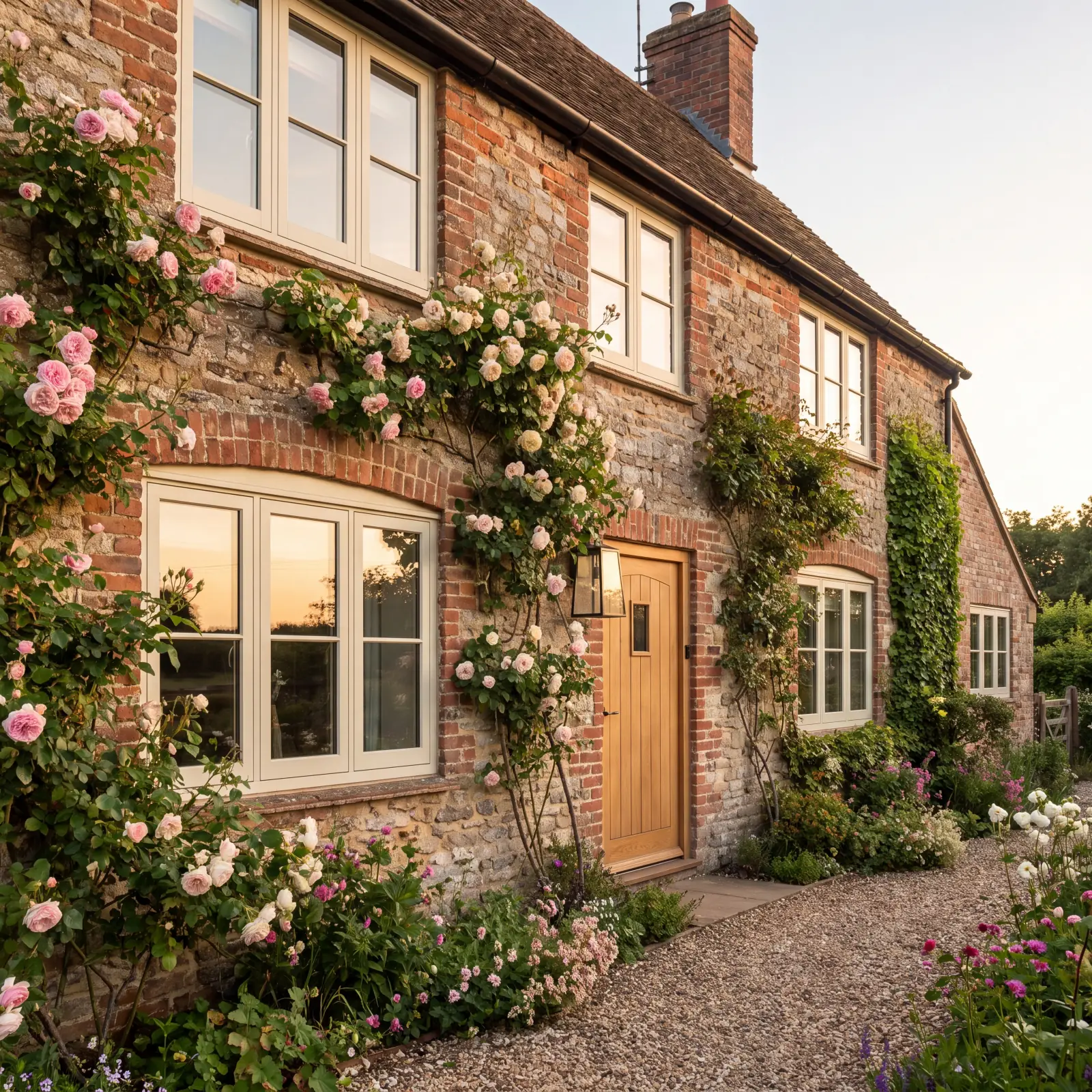
Look closely at an original timber casement on a period house and you'll spot something standard uPVC never copied. The sash sits level with the frame. One clean plane, the way a cabinet door sits in a cabinet. Standard uPVC casements lip over their frames instead, and that stepped, stacked look quietly announces 'replacement window' from right across the street. Flush casements fix precisely this, and their climb from niche product to bestseller is the biggest style story British windows have had in a decade.
What a flush casement actually is
In a flush casement, the opening sash closes fully into the frame so the outside face becomes one flat plane. No overlap, no step, no shadow line beyond the neat gap around the sash. That single geometric change recreates the look of traditional timber joinery for the simple reason that it is the geometry of traditional timber joinery. Add a woodgrain or painted-effect finish and mechanical-look joints, and from the pavement a good flush casement in uPVC or aluminium passes comfortably for restored timber.
Why flush casements took over
- They flatter both directions. On a period home the style restores authenticity; on a contemporary one the clean plane reads as minimal and architectural. Very few window styles manage both streets.
- The heritage market grew up. People replacing first-generation uPVC on Victorian and Edwardian streets want windows the architecture deserves, and flush is the natural entry point.
- Planners like them. In conservation areas, flush profiles in the right colours are frequently what gets a sympathetic replacement approved.
- Nothing is sacrificed. Modern flush systems carry the full specification, meaning A++ glazing, multi-chambered or thermally broken frames and PAS 24 hardware. The look is period. The engineering isn't.
Design choices that make or break the look
The flush geometry is only the canvas. Colour does much of the work. Creams, sages, off-whites and greys read as paint, while brilliant white reads as plastic. Finish matters too, and smooth painted-effect surfaces are having their moment precisely because they suit the timber illusion. Glazing bars should be mechanically bonded or integral, with proportions matched to the street, never flimsy stick-ons. Hardware finishes the sentence. Monkey-tail or pear-drop handles in graphite or pewter complete a period scheme, while sleek stainless suits a modern one. Cheap flush windows do exist, and they miss on exactly these details. The geometry alone won't carry it.
uPVC or aluminium flush casements?
Both exist, and both convince. uPVC flush systems are the volume choice, with excellent thermal figures, woodgrain foils and sensible pricing. Aluminium flush casements bring slimmer sightlines and powder-coat durability, and they suit projects that pair flush windows with slimline doors and screens. For most Manchester period homes, quality uPVC flush in a heritage colour is the value sweet spot. Aluminium earns its premium on larger openings and design-led projects.
What flush casement windows cost
Expect 10-20% over equivalent standard casements, because the sash engineering and gasketry are genuinely more involved. Set that against heritage vertical sliders, which run roughly double a standard casement, and flush becomes the affordable route to a period-appropriate elevation. That arithmetic explains its steady march across Manchester's terraced streets. On a typical semi, choosing flush over standard adds a few hundred pounds to a whole-house job, and in our experience it's the upgrade people regret least.
Where we'd specify flush without hesitation
Victorian and Edwardian terraces and semis replacing tired standard uPVC. Cottages, and anything rendered or in painted brick, where heritage colours really sing. Conservation-adjacent streets that want a planner-friendly replacement. And modern houses chasing that flat, minimal plane. Where would we pause? On a rental refurbishment with a stretched budget, standard casements spend the difference better, and if the house genuinely calls for sliders, a flush casement is the second-best answer rather than the first. Every flush window we make is fabricated to measure in Trafford Park, with the bars, colour and hardware specified house by house.
Getting the whole elevation right
Flush casements reward whole-elevation thinking. Pair them with a front door in a complementary heritage colour, because the window-and-door ensemble is what the street actually sees, and carry the glazing bar pattern consistently across every window rather than mixing barred and plain openings. If the house has a bay, the bay sets the tone. Get its proportions and bars right and the rest follows. One plea from our fitters: don't mix flush and standard casements on the same facade to save money. The stepped-versus-flat difference is exactly what the eye catches, and the saving stays visible from the pavement forever. If budget forces phasing, phase by elevation and never by window. Flush casement buyers are, almost by definition, people who noticed the details.
Frequently asked questions
What is a flush casement window?
A casement whose opening sash closes level with the frame, giving one flat exterior plane. It's the geometry of traditional timber joinery, now manufactured in uPVC and aluminium with modern glazing and security.
Are flush casement windows more expensive?
Typically 10-20% over standard casements, and still far cheaper than heritage vertical sliders. That's why they've become the default upgrade for period streets wanting authenticity on a sensible budget.
Do flush casements suit modern houses?
Yes, and unusually the style works both ways. The flat plane reads as traditional on period homes and as clean minimalism on contemporary ones, especially in greys and darker shades with slim hardware.
Are flush casements allowed in conservation areas?
Often they're exactly the approved solution. Flush profiles in appropriate colours with correct glazing bars are what many planners consider a sympathetic replacement. Check your street's status first, and lean on the application-ready detailing a heritage-aware fabricator can supply.
Is a flush casement as weatherproof as a standard one?
Quality flush systems seal on multiple gasket lines engineered for the flush geometry and perform identically in testing, North West weather included. As ever, the system and the fabrication matter more than the style.
What colours work best on flush casement windows?
Heritage tones such as cream, sage, agate grey and off-black sell the painted-timber illusion best, and smooth finishes are increasingly preferred over woodgrain for the same reason. Brilliant white gloss is the one choice that undoes the effect.
See the flush difference against your house
We bring flush and standard corner samples to every free survey, and the difference needs no explaining once you've held both. We'll quote your house in heritage colours, made to measure in Manchester and backed by a 10-year guarantee.
Call 07533 830717, WhatsApp us a photo for a fast quote, or request a free quote online.