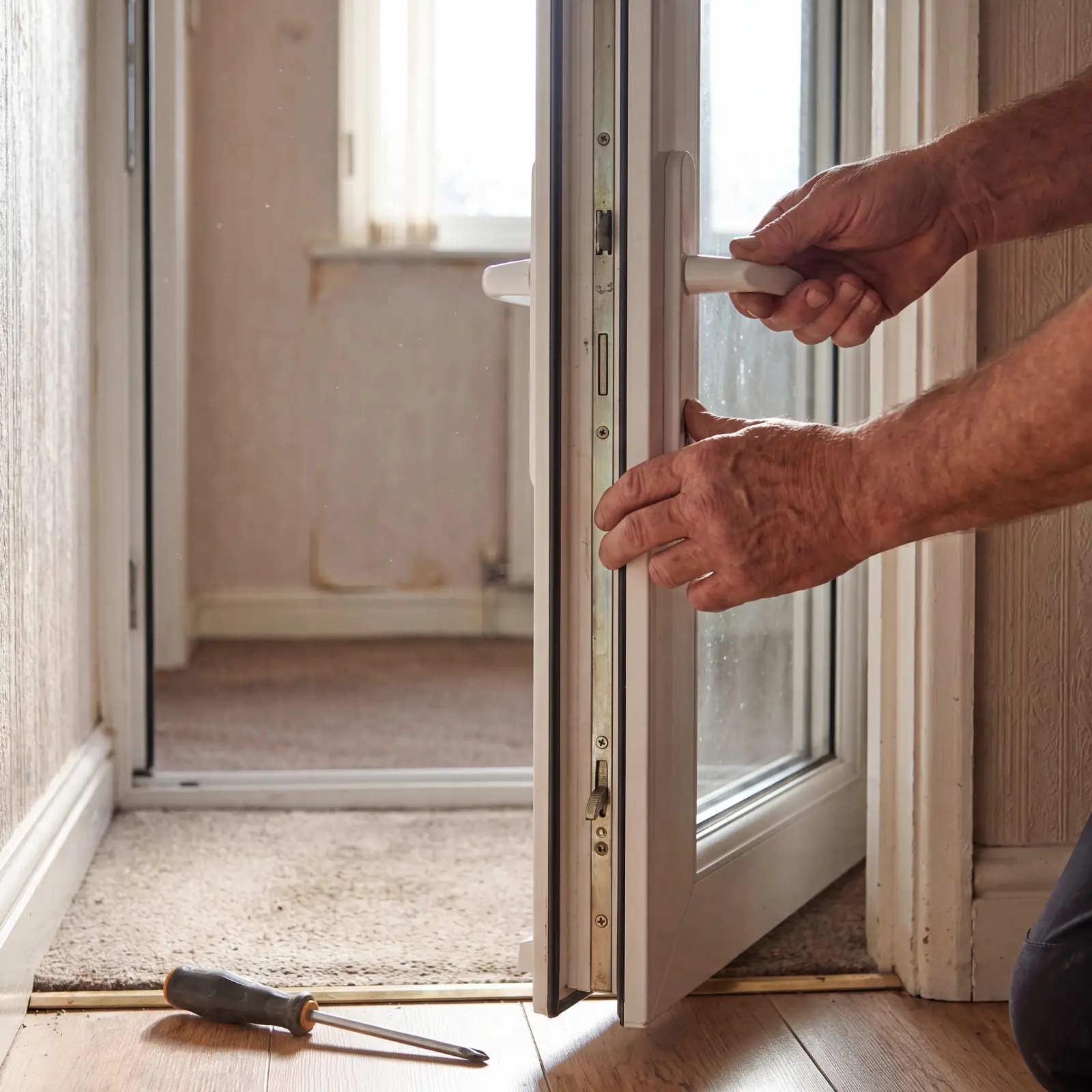
It always happens at the worst moment, doesn't it? You're heading out for work or locking up at midnight, and the handle won't lift. Or it lifts, but the key won't turn. Or the whole thing needs a shoulder against the door and a bit of luck. A uPVC door that won't lock is a security emergency in slow motion, yet it's usually a fifteen-minute diagnosis, because the same six faults cover nearly every case.
Work through these in order. They run from free fixes to jobs for an engineer.
Start with the one-minute test
Open the door and try the mechanism with it standing open: lift the handle, turn the key. Does everything move sweetly open but fight when the door's closed? Then your mechanism is fine. The door and frame are out of line, which is by far the most common answer. If it's stiff or jammed even with the door open, the fault sits in the lock hardware itself. That single test cuts the problem in half straight away.
Fault 1: The dropped door (misalignment)
uPVC doors are heavy, and they hang on adjustable hinges. Over the years they drop or drift until the locking points no longer meet their keeps. The tell-tale signs: it locks fine if you lift the door at the handle edge, there are scuff marks on the keeps, and the gaps between door and frame look uneven. Hinge adjustment is the fix. Most modern flag hinges adjust with an Allen key for height, lateral position and compression, and small patient turns (quarter-turn, test, repeat) often cure it completely. Hinges already at their limits, or a warped door? That's an engineer's visit.
Fault 2: The tired gearbox
The gearbox is the central mechanism your handle drives, and it rarely dies without warning. The handle gets stiffer or floppier over a few weeks, lifts sluggishly, then one day jams solid, sometimes with the door trapped shut. Whatever you do, don't force it. Forcing snaps the internal follower and turns a repair into a lockout. The good news? Gearboxes are standard replaceable parts, and an engineer swaps one in under an hour for far less than a new door costs. If your handle has felt wrong for a fortnight, book the swap before it strands you.
Fault 3: The snapped or seized cylinder
Key turns but nothing happens, or won't go in at all, or the cylinder spins loosely? Those are cylinder faults. Sometimes it's just muck, and graphite or silicone lubricant (never oil, which gums everything up) will revive a gritty cylinder. A cylinder that's genuinely failed, or worse, shows signs of tampering, needs replacing. And that's the moment to fit an anti-snap 3-star cylinder, since lock snapping is still the region's favourite burglary method. Replacement takes about ten minutes and one retaining screw.
Faults 4-6: keeps, hooks and weather
- Shifted keeps: the plates on the frame side that the hooks land in can work loose or move. Look for bright scratch marks showing where the hooks strike. Adjusting or repositioning them is straightforward work for an engineer.
- Debris and dry tracks: hooks and rollers gummed up with grime will bind the whole strip. A clean and a squirt of silicone spray once or twice a year keeps everything gliding. Cheapest fix in this article.
- Thermal movement: a door that only misbehaves in heatwaves or cold snaps is expanding and contracting. Occasional seasonal stiffness you can live with; if it locks you out every year, compression adjustment (or replacement, on old flexible doors) is the cure.
When it's the door, not the lock
Some doors reach the point where honesty is kinder. Warped slabs that no adjustment will square, 1990s panels flexing around their locks, hardware so obsolete nobody stocks it. Persistent locking trouble on an old door is usually the door announcing its retirement, and a modern composite replacement locks better, insulates better and carries PAS 24 security the old door never had. Our door repair team fixes what's fixable and tells you straight when it isn't; if you're locked out and it's urgent, that's what the 24/7 emergency line is for.
Five minutes a year prevents nearly all of this
Twice a year, do this. Wipe the locking strip and keeps clean. Silicone-spray the hooks, rollers, hinges and cylinder. Check the handle lifts smoothly with the door open, then glance at the gaps around the closed door for creeping misalignment. It works out at about sixty seconds per door, and it's the difference between hardware lasting ten years and lasting twenty. Same logic as our full maintenance routine for windows and doors.
One last thing. If you're reading this late at night with a door that won't lock at all, don't leave it and hope. Wedge it from the inside, move anything valuable out of the immediate room and ring a 24/7 service. An unlockable door is exactly the vulnerability opportunists check for, and one visit tonight beats explaining to your insurer why the house was left unsecured. Most 'won't lock' emergencies get solved in a single visit with a gearbox, a cylinder or an adjustment. The door is rarely as doomed as it feels at 11pm.
Frequently asked questions
Why won't my uPVC door lock when I lift the handle?
Test it with the door open. If it locks sweetly open but not closed, the door has dropped and the hinges need adjusting so the hooks meet their keeps. Stiff with the door open too? The gearbox or cylinder is failing. Stop forcing it and get it swapped before it jams completely.
Can I adjust a dropped uPVC door myself?
Often, yes. Modern flag hinges take an Allen key, and patient quarter-turn adjustments (height first, then lateral) cure a lot of dropped doors. Work in small increments and test constantly. If the hinges are at their limits, or the slab has warped, call a professional.
How much does it cost to fix a uPVC door lock?
Typical Manchester prices: cylinder replacement £60-£120 (fit anti-snap while you're at it), gearbox replacement £90-£180, hinge and keep realignment £60-£100. All are fractions of what a new door costs. The expensive mistake is forcing a failing mechanism until it strands you.
My key won't turn in the uPVC door - what do I do?
Lift the handle fully first, because multipoint locks need full engagement before the key will turn. Then lubricate the cylinder with graphite or silicone. If the key still won't turn, especially from outside, call a locksmith rather than forcing it. A snapped key turns a small job into a bigger one.
Why does my uPVC door only stick in summer?
Thermal expansion. Dark doors in direct sun grow measurably and bind against their frames. Occasional seasonal stiffness is normal; annual lockouts justify a compression adjustment, or point to an older flexing door that's due for replacement.
Is a stiff door handle dangerous to ignore?
It's the classic warning sign. Gearboxes get stiff before they jam, usually within weeks. A £100 gearbox swap at the stiff stage beats an emergency call-out with the door stuck shut, often on the very evening you're due to go out.
Door fighting you?
Send us a video of the handle and we'll usually diagnose it on the spot. Repairs across Greater Manchester, anti-snap upgrades while we're there, and honest advice when a door is past saving. We're on call 24/7 if you're locked out tonight.
Call 07533 830717, WhatsApp us a photo for a fast quote, or request a free quote online.