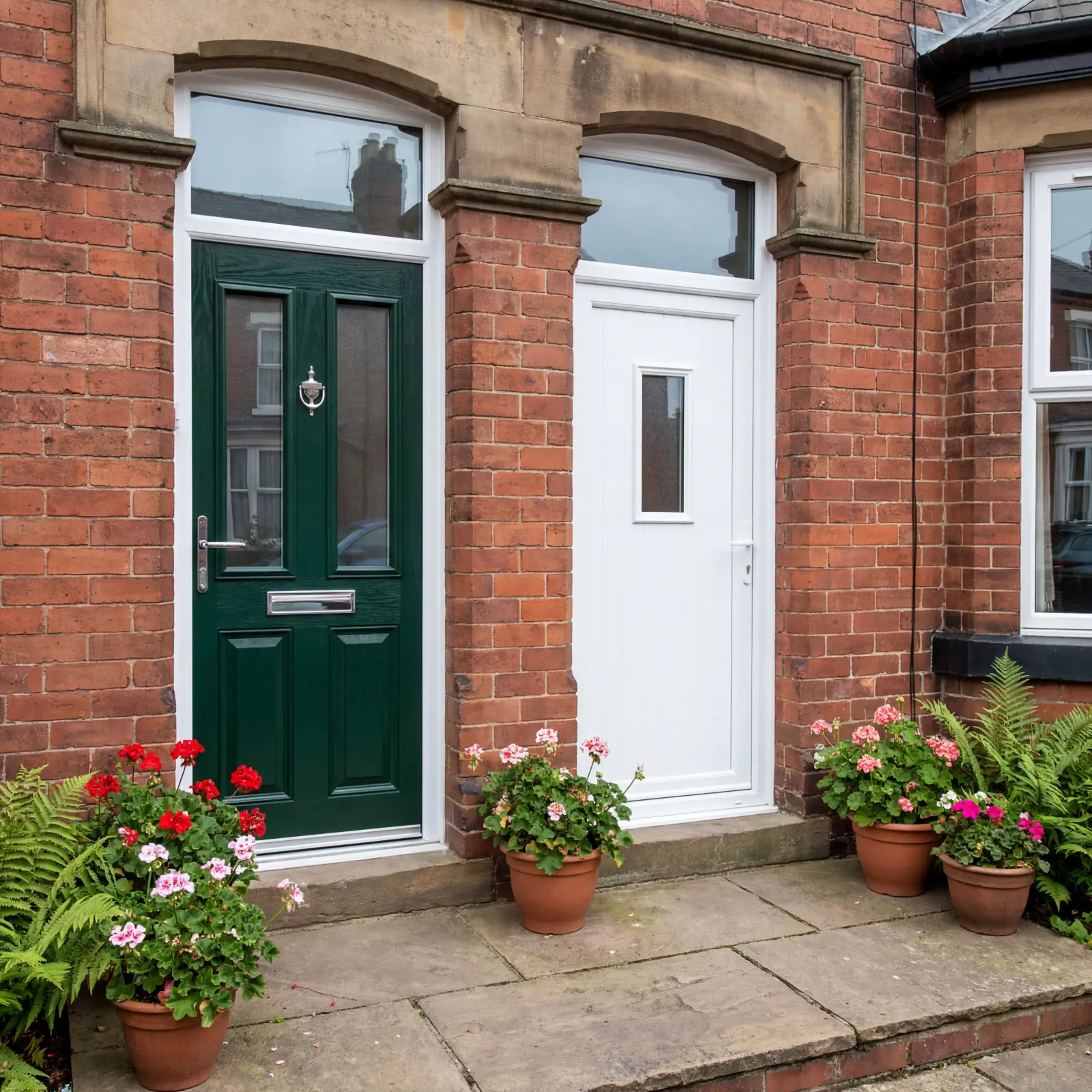
A front door has three jobs. Keep the weather out, keep intruders out, and look good doing both for twenty years. Composite and uPVC doors can each manage all three, but they go about it differently, at different prices, and the right pick depends on your budget, your street and how much the door matters to the face of the house.
We fabricate and supply both here in Manchester, so here's the comparison with the sales gloss stripped off.
What each door is made of
A uPVC door is a reinforced uPVC frame carrying insulated panels or glass. It's the value option. Light, weatherproof, low-maintenance, and available in a growing range of colours and styles.
A composite door is a sandwich. A solid or foam-insulated core (ours is 44mm) gets wrapped in a tough GRP (glass-reinforced plastic) skin with a realistic timber grain, then hung in a reinforced frame. It's heavier, stiffer, more thermally efficient, and far more convincing as a 'proper' front door.
Head to head
| Factor | uPVC door | Composite door |
|---|---|---|
| Typical fitted price (2026) | £650-£1,100 | £950-£2,200 |
| Thermal performance (U-value) | 1.4-1.6 | 1.0-1.2 |
| Security | Good with multi-point lock | Excellent, thick slab resists impact |
| Kerb appeal | Clean but plastic-looking | Convincing timber look, deep colours |
| Colour stability | Good (white best) | Excellent. GRP skin resists fading |
| Lifespan | 20-25 years | 30-35 years |
| Maintenance | Wipe clean | Wipe clean |
Security is where you feel the difference
Both doors take the same quality of multi-point lock and anti-snap cylinder, and both, from us, meet PAS 24. The difference is the slab itself. A composite door's 44mm core simply shrugs off brute force in a way a hollow uPVC panel can't. If security is your priority, and after a break-in it usually is, composite wins. (Had a burglary and need the property secured tonight? Our 24/7 boarding-up and locksmith team covers all of Greater Manchester.)
Whichever way you go, insist on a 3-star or anti-snap cylinder, because the lock barrel rather than the door is what most burglars attack. There's more in our guide to window and door security standards.
Warmth and weather
The insulated core gives a composite door a meaningfully better U-value, and its stiffness means it seals more consistently against Manchester's horizontal rain. uPVC slabs can flex slightly in extreme temperature swings, which is the usual story behind 'my door sticks in summer'. For an exposed, weather-facing entrance, composite is the more forgiving choice. In a sheltered porch, uPVC does the job perfectly well.
Looks, colours and value on the street
Kerb appeal is where composite earns its premium. A grained GRP skin in a deep colour, anthracite, racing green, navy or black, reads as an expensive timber door from the pavement, and any estate agent will tell you the front door punches well above its weight in first impressions. Improving the house to sell? The £300-£600 step up to composite typically returns itself, part of the wider case we set out in do new windows add value to your house.
So which should you buy?
- Choose uPVC if: budget leads, the door is sheltered, it's a rental or a secondary entrance, or you simply want the cheapest route to a secure, weatherproof, zero-maintenance door.
- Choose composite if: it's your main entrance, you want the best security and insulation, the door faces the weather, or kerb appeal matters. Most of our Manchester customers picking a front door go composite, with uPVC on the side and back doors.
Every composite and uPVC door we supply is made to measure with a 6-point lock, anti-snap cylinder and a 10-year guarantee, fitted by our own installers rather than subcontractors. And if the existing door just needs realigning or a fresh lock rather than replacing, our door repair team will say so.
Three real-world scenarios
The exposed Victorian terrace. Front door opens straight onto the street, faces west, and takes the full force of the Manchester weather. Composite, no hesitation. The insulated slab stops the hallway acting as a cold buffer, the GRP skin shrugs off driving rain, and the timber look suits the street. This is the door composite was invented for.
The sheltered 1970s semi with a porch. Here the front door never sees direct rain, and the porch already provides a thermal airlock. A quality uPVC door with a 3-star cylinder does everything the house asks of it, and the £400 saved goes towards the windows.
The buy-to-let flat entrance. Tenanted properties want durable, secure and economical. A uPVC door built to PAS 24 spec with an anti-snap cylinder ticks compliance and keeps costs sensible, though on street-facing entrances some landlords now go composite purely because it needs zero attention between tenancies.
A quick word on aluminium doors
There's a third option at the premium end. Aluminium entrance doors bring slim frames, large glass and powder-coated colour that matches aluminium windows. They're the pick for modern architectural homes and pair naturally with bifold and sliding doors at the rear. For classic streets, composite remains the sweet spot of warmth, security and looks.
Frequently asked questions
Are composite doors worth the extra money over uPVC?
For a main entrance, usually yes. Better insulation, noticeably better security and a look that holds its value. For sheltered side and back doors, uPVC delivers 90% of the function at 60% of the price.
How long do composite doors last?
30+ years with basic care. The GRP skin stands up to dents, fading and weather far better than painted timber, and unlike timber it never wants sanding or repainting.
Do composite doors fade in the sun?
Quality GRP skins are highly UV-stable, even in dark colours. Cheap composite doors with thin skins can chalk over the years, which is one of several reasons to buy on specification rather than price alone.
What's the most secure front door?
A PAS 24 composite door with a 6-point multi-point lock and a 3-star anti-snap cylinder is about as secure as domestic doors realistically get. The cylinder rating matters every bit as much as the door itself.
Can you match a composite door to my windows?
Yes. We colour-match doors to our window frames across standard and RAL colours, with dual-colour options (one colour outside, another inside) available on both doors and windows.
How long does it take to fit a new front door?
Half a day in most homes. The old door and frame come out, the new pre-hung set goes in, and it's sealed, adjusted and handed over on the same visit. Made-to-measure manufacture takes two to four weeks beforehand, so survey to finished door typically runs under a month.
See both doors side by side
Tell us your budget and we'll price a uPVC and a composite option for the same opening, both made to measure in Manchester with PAS 24 security and a 10-year guarantee. Then the choice is genuinely yours to make.
Call 07533 830717, WhatsApp us a photo for a fast quote, or request a free quote online.