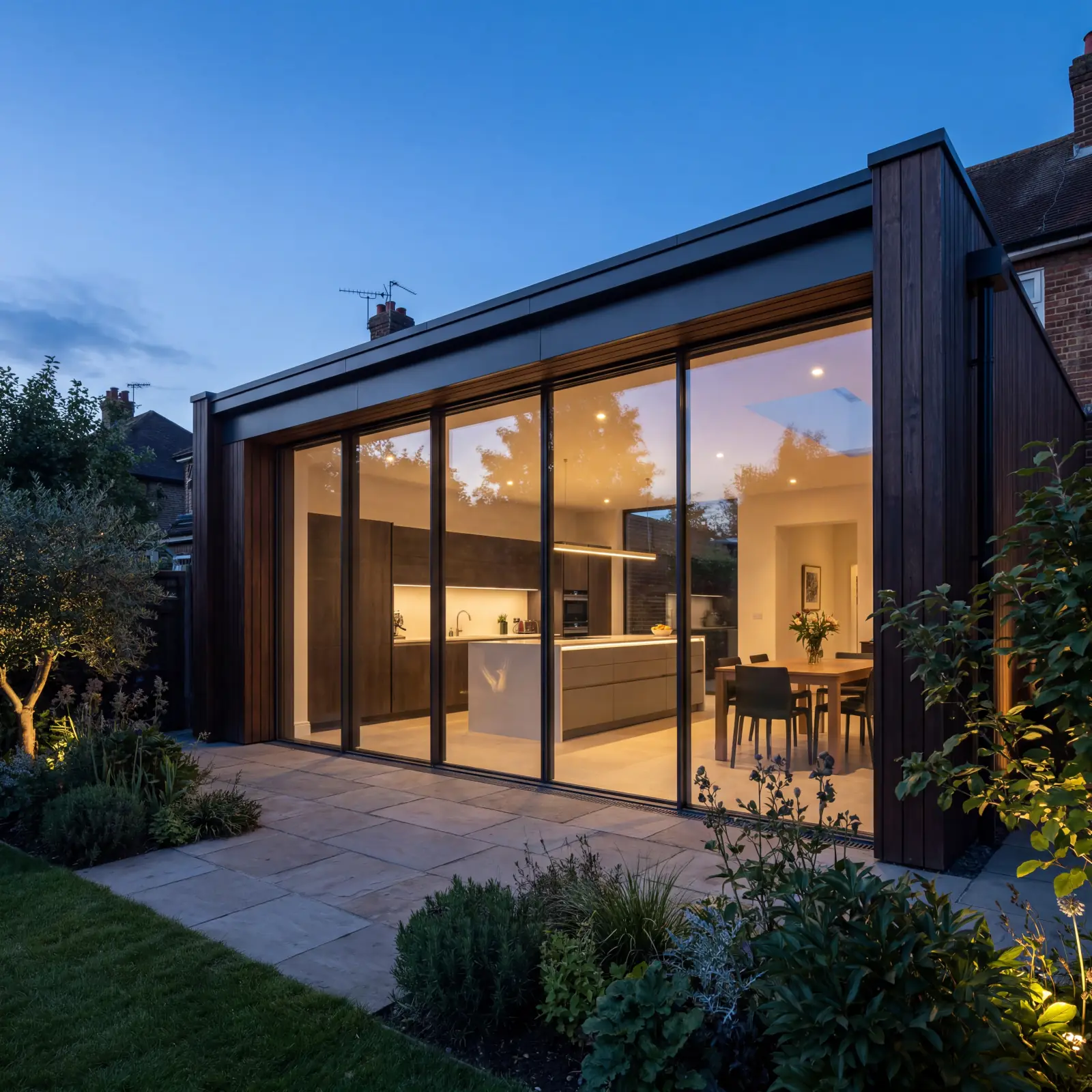
Every kitchen extension reaches the same junction eventually. The rear wall is becoming glass, and the glass has to be either a bifold or a slider. Both promise the garden connection the whole project was for, but they deliver it in genuinely different ways, and the choice shapes how the room looks every single day rather than just on the six days a year when British weather permits a fully open wall. We build both in the factory constantly, so let's work through the decision properly.
The fundamental trade
Bifolds concertina their panels to one or both sides, opening up to 90% of the aperture. That's the genuine open-wall, inside-outside party trick. The cost is frames, because each panel carries its own surround, so a closed bifold shows a rhythm of vertical frame lines. Sliders run enormous panels past each other on tracks. Half the aperture opens, or two-thirds on three-track systems, but the panels themselves are huge. Single panes of 2.5 metres and beyond are routine, so the closed door is almost all glass. Closed view versus open wall. That's the entire trade, and everything else is detail.
How often will you actually open them?
Count the days. A Manchester extension's doors stand fully open perhaps 15-30 days a year, and they're looked at, closed, every day of every winter. That arithmetic nudges plenty of buyers toward sliders, since you live with the view and only occasionally use the opening. The counter-argument is real too. On the days a bifold opens completely, the room transforms in a way a half-open slider never matches, and households that entertain outdoors weight those days heavily. Neither answer is wrong. The mistake is buying the open-wall fantasy without noticing you've also bought the closed-door reality.
Side by side
| Factor | Bifold | Sliding |
|---|---|---|
| Max opening | ~90% of aperture | 50-66% of aperture |
| Closed appearance | More frame lines | Maximum glass, minimal frame |
| Typical cost | Higher per metre | 10-20% less |
| Daily door function | Traffic door (specify it!) | Panels slide easily |
| Threshold options | Low/flush available | Low/flush available |
| Space when open | Panels stack at the side | Panels stay in plane, zero intrusion |
| Best suited to | Full-width entertaining, patios | Views, gardens, winter living |
Details that decide real satisfaction
- The traffic door. A bifold without a single-opening lead door forces you to fold panels for every trip to the washing line. Always specify one. It's the difference between loving bifolds and resenting them.
- Slider engineering. Big panels weigh hundreds of kilos. Quality running gear moves them with a finger, while budget gear turns them into a gym session by year three. This is where cheap-vs-quality bites hardest.
- Corners and configuration. Sliders handle open-corner and pocket arrangements, where panels vanish into the wall, beautifully. Bifolds turn corners with posts. Ambitious geometry favours sliding systems.
- Glass specification. South- or west-facing glass walls need solar control glass or the extension overheats. Both systems take it, and few budget quotes include it. Big panes near roads also deserve a look at acoustic laminate.
- Security. Both achieve PAS 24 with multi-point locking. Laminated glass upgrades matter more here than anywhere else, because glass walls are the modern back door.
Prices, and the third option
For budgeting, quality aluminium bifolds run £1,500-£2,500 per panel installed, and the full breakdown lives in our bifold cost guide. Comparable sliders typically come in 10-20% less for the same aperture, with fewer, larger panels. And don't forget the third option for openings under about 2.4m. Quality French doors with flanking fixed panes deliver light, opening and charm at a fraction of either. Sometimes the right answer for a smaller extension is the one nobody's Instagram suggested.
Our rule-of-thumb recommendations
Choose the slider when the garden view is the room's main event, when the opening exceeds four metres, or when winter aesthetics dominate. Choose the bifold when full-width opening genuinely matches how you entertain, when a traffic door will handle daily use, or when the aperture sits in the 2.4-4m band where bifold economics are strongest. Households that can't decide end up happier with sliders more often than not, because the every-day view outvotes the some-days opening. Both are fabricated to measure in our Manchester factory and colour-matched to windows across the project, with a 10-year guarantee either way.
The showroom test that settles it
Still torn after all the logic? Do what our happiest customers do and operate both, fully, several times. Slide a big panel with one finger. Fold a bifold wall open and shut completely, including the traffic door on its own. Stand where your sofa will be and look through each closed system at eye level. And bring the household member who'll use the doors most, because the person cooking at the island has different priorities from the person who chose the tiles. Ten minutes of physical operation reveals preferences no comparison table can reach, and whichever door you catch yourself operating a second time for the pleasure of it is usually the answer. Doors are the most physical purchase in this whole series. Buy them physically.
Frequently asked questions
Which is cheaper, bifold or sliding doors?
Sliders usually run 10-20% less than bifolds for the same aperture, because fewer, larger panels mean less hardware and fabrication. French doors undercut both on openings under about 2.4 metres.
Which gives a better view, bifold or sliding doors?
Sliding doors, decisively. The panels are far larger, so the closed elevation is almost uninterrupted glass, while a closed bifold shows a frame line every 700-1,000mm. If the winter view matters most, that's usually the deciding fact.
Do bifold doors open fully?
Yes. The panels concertina to one or both sides, clearing around 90% of the aperture, which is the genuine open-wall effect sliders can't match. Specify a traffic door so daily access doesn't mean folding the whole wall.
Are sliding doors secure?
Quality modern sliders carry multi-point hook locks, anti-lift hardware and PAS 24 certification, with laminated glass as the sensible upgrade for any glass wall. The old track-and-latch insecurity belongs to previous generations of system, not current ones.
Can you get level thresholds on both?
Yes. Flush and low thresholds are available for bifolds and sliders alike, provided the drainage outside is detailed properly. Decide at order time, because it affects the floor build-up and is miserable to retrofit.
What width opening do I need for each?
Bifolds work from about 1.8m with two panels up to 7m and beyond, with a sweet spot of 2.4-4m. Sliders start making sense around 2.4m and get stronger as openings grow. The bigger the aperture, the better the slider's case.
Price both against your actual opening
Send us your opening width or plans and we'll quote a bifold and a slider side by side, with panels, glass spec, thresholds and colours all itemised, from our Trafford Park factory and with a 10-year guarantee on either.
Call 07533 830717, WhatsApp us a photo for a fast quote, or request a free quote online.