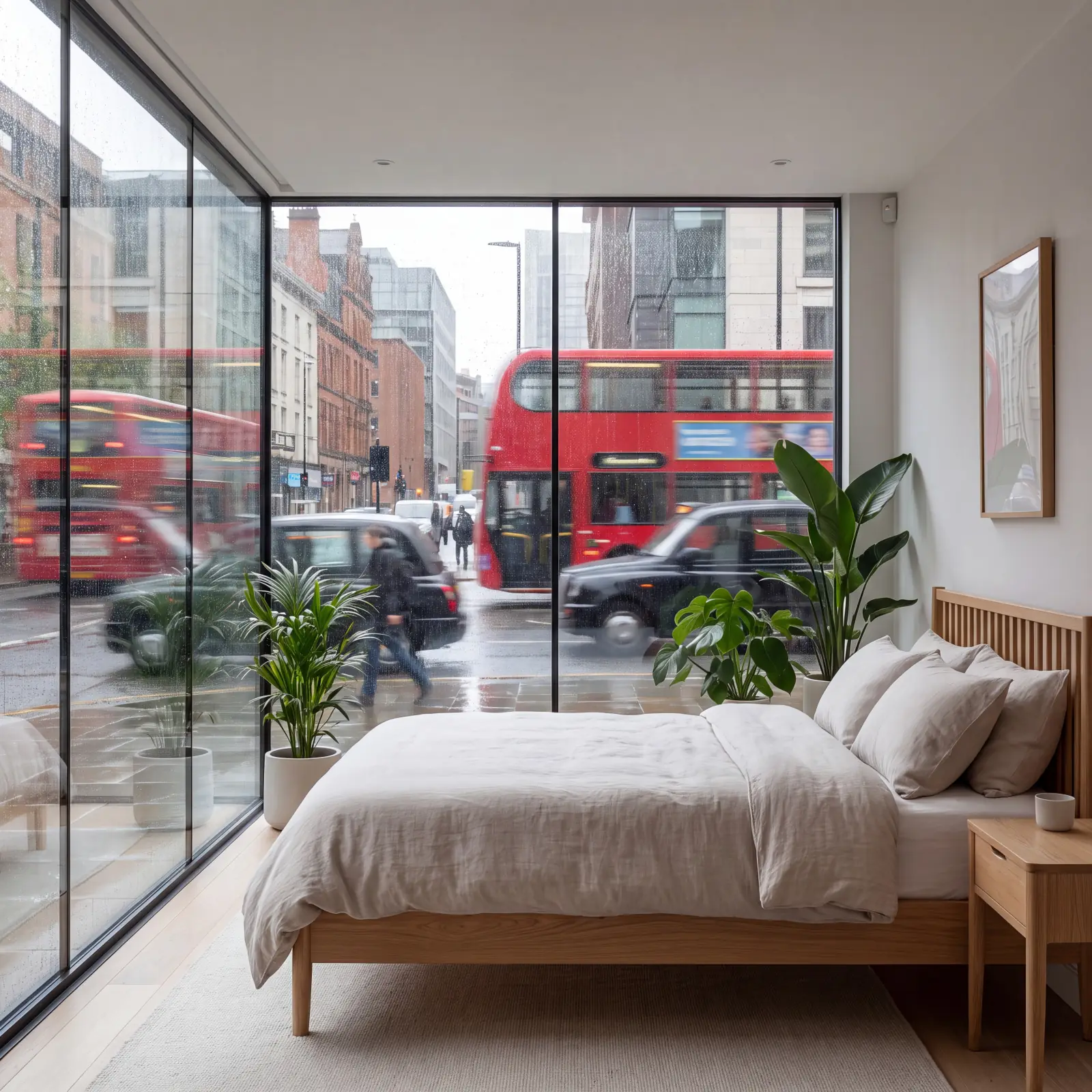
Manchester isn't a quiet city. Between the arterial roads, the trams, the Airport approach over the southern suburbs and the ordinary churn of a million people, most of us live with a background hum we've long stopped consciously hearing. Then we sleep somewhere quiet and realise what we've been tuning out. And noise isn't just an annoyance. Sustained exposure measurably disturbs sleep, concentration and blood pressure, which is why acoustic glazing has gone from a niche product to one of the upgrades we're asked about most.
So how does sound actually get through a window, what do the decibel claims mean, and how do you buy quiet without wasting money? Let's take those in order.
How sound defeats an ordinary window
Sound is vibration, and it crosses a window in three ways. It shakes the glass itself, which then re-broadcasts the noise on the inside. It resonates through the air cavity between the panes. And it sneaks through any air gap it can find, whether that's perished gaskets, trickle vents or poor perimeter seals. Standard double glazing was designed for heat and does little to interrupt any of this. Two identical panes resonate at the same frequency and cheerfully pass traffic rumble straight through, which is why 'we already have double glazing' and 'we can hear everything' so often describe the same house.
The three tricks of acoustic glazing
- Asymmetric glass. Different thicknesses for the two panes, say 6mm outside and 4mm inside, so each pane deadens the frequencies the other passes. Cheap, effective, and the first thing to specify.
- Acoustic laminate. A pane made of two glass layers bonded by a sound-damping PVB interlayer that turns vibration into imperceptible heat. This is the heavy artillery, and the same construction happens to make glass very hard to smash through, so security improves free of charge.
- Optimised cavities and sealing. Wider gaps shift resonance helpfully, and meticulous gasket and perimeter sealing closes the airborne flanking paths that would otherwise undo everything else.
What the decibel numbers really mean
Windows carry an Rw rating, which is the lab-measured sound reduction in decibels. Old single glazing manages around Rw 25. Standard double glazing sits at Rw 29-32, asymmetric acoustic double glazing reaches Rw 35-38, and laminated acoustic specifications get to Rw 40-42. Decibels are logarithmic, so every extra 10dB of reduction sounds roughly half as loud to the human ear. That means moving from tired standard units in the low 30s to a 40-plus specification doesn't just take the edge off traffic noise. It roughly halves its perceived loudness, and residents typically describe the road as having moved several streets away.
| Glazing | Typical Rw | What you hear |
|---|---|---|
| Single glazing | ~25dB | Conversations on the pavement |
| Standard double glazing | 29-32dB | Steady traffic rumble, sirens clearly |
| Acoustic double (asymmetric) | 35-38dB | Traffic faint, sirens softened |
| Acoustic laminated spec | 40-42dB | Heavy traffic reduced to a murmur |
Spend where the noise is
Acoustic glazing prices per pane, so target it. Bedrooms and living rooms facing the road get the full laminated spec, while rear elevations usually need nothing beyond good standard units. Keep the flanking paths in mind too, because a letterboxed front door or a permanently open trickle vent can undermine premium glass, so acoustic vents and a well-sealed composite door belong in the plan. And if your existing frames are sound, acoustic sealed units can often go into them via glass-only replacement. That's the budget route to a quiet bedroom.
Cost, and the double payback
Expect acoustic laminated units to add roughly £60-£150 per window over standard A++ glazing, so on a road-facing three-window elevation you're adding a few hundred pounds to the project. The payback comes twice over, because of what arrives free. Laminated glass is the security upgrade that defeats smash-and-reach attacks, and the thermal spec is unchanged, so the energy savings turn up regardless. Quiet, secure and warm turn out to be the same window.
What acoustic glazing can't do
No window silences a nightclub or a flight path directly overhead. Beyond Rw 42 the returns diminish, and secondary glazing, meaning a separate internal pane with a large air gap, becomes the specialist answer, reaching reductions windows alone can't manage. Glazing also can't fix noise arriving through walls, roofs or chimneys. A supplier who asks where the noise comes from and when it bothers you, rather than quoting 'soundproof windows' sight unseen, is the one who'll actually solve the problem.
A note on Manchester's noise map
Local knowledge changes specifications. Homes under the Airport's approach paths in Heald Green, Gatley and parts of Stockport benefit most from laminated specifications tuned to aircraft frequencies, and they may qualify for the Airport's own insulation schemes, which is worth checking before you spend a penny. The tram network's characteristic rumble along Metrolink corridors responds particularly well to asymmetric glass. Then there's the classic Manchester scenario, a fine Victorian terrace on what became an arterial road, which usually combines heritage style constraints with the region's worst noise exposure. Heritage-look windows with acoustic laminated units solve both at once, and jobs like that are some of the most satisfying work we do.
Frequently asked questions
Do soundproof windows really work?
Properly specified acoustic glazing genuinely halves perceived traffic noise against tired standard units, Rw 40-plus versus the high 20s. What doesn't work is expecting the words 'double glazing' alone to deliver it. The acoustic construction is what does the work.
How much do acoustic windows cost?
Typically £60-£150 per window over standard A++ glazing for laminated acoustic units, or from around £100 per pane as glass-only replacement into sound existing frames. Targeting only the noise-facing rooms keeps whole-house costs modest.
Is triple glazing better than acoustic double glazing for noise?
Usually not. Three identical panes can resonate together, and a quality asymmetric or laminated double unit typically outperforms standard triple glazing acoustically. Buy triple for heat and acoustic laminate for noise, and combine them where both matter.
Can I soundproof my existing windows without replacing them?
If the frames are sound and well-sealed, yes, via acoustic sealed units fitted into the existing frames plus new gaskets. If the frames leak air, flanking noise undermines any glass you fit, and replacement or secondary glazing becomes the sensible answer.
What about noise through trickle vents?
A real flanking path, but the answer is acoustic trickle vents with baffled airflow, not sealing vents shut, which just trades noise for condensation and mould. Regulations require background ventilation for good reason.
Which rooms should get acoustic glazing first?
Bedrooms facing the noise source, then living spaces. Sleep disturbance is where noise does its documented health damage, and one quiet bedroom often transforms quality of life more than a whole-house upgrade would.
What is acoustic glass?
Acoustic glass is laminated glass built with a sound-damping PVB interlayer between two panes. The interlayer converts sound vibration into tiny amounts of heat instead of passing it through, so the pane stops re-broadcasting noise into the room. It is the single most effective component in an acoustic glazing specification.
Is acoustic glass the same as laminated glass?
Not quite. All acoustic glass is laminated, but not all laminated glass is acoustic. Standard laminate uses a clear safety PVB interlayer designed to hold the glass together on impact. Acoustic laminate uses a softer, specially formulated interlayer tuned to damp sound. They look identical, so ask for the acoustic grade by name rather than assuming laminated means quiet.
What thickness of acoustic glass do I need?
Common acoustic laminates are 6.8mm, 8.8mm and 12.8mm, and thicker is not automatically better. What matters more is asymmetry: pairing different pane thicknesses either side of the cavity, say 6.8mm acoustic laminate against 4mm, so each pane damps the frequencies the other lets through. A well-chosen asymmetric pair beats a thicker symmetric one most of the time.
Tell us what you're trying not to hear
Road, tram, pub or flight path. Describe the noise and the rooms it reaches, and we'll specify acoustic glazing pane by pane, manufactured in our Manchester factory and guaranteed for 10 years.
Call 07533 830717, WhatsApp us a photo for a fast quote, or request a free quote online.