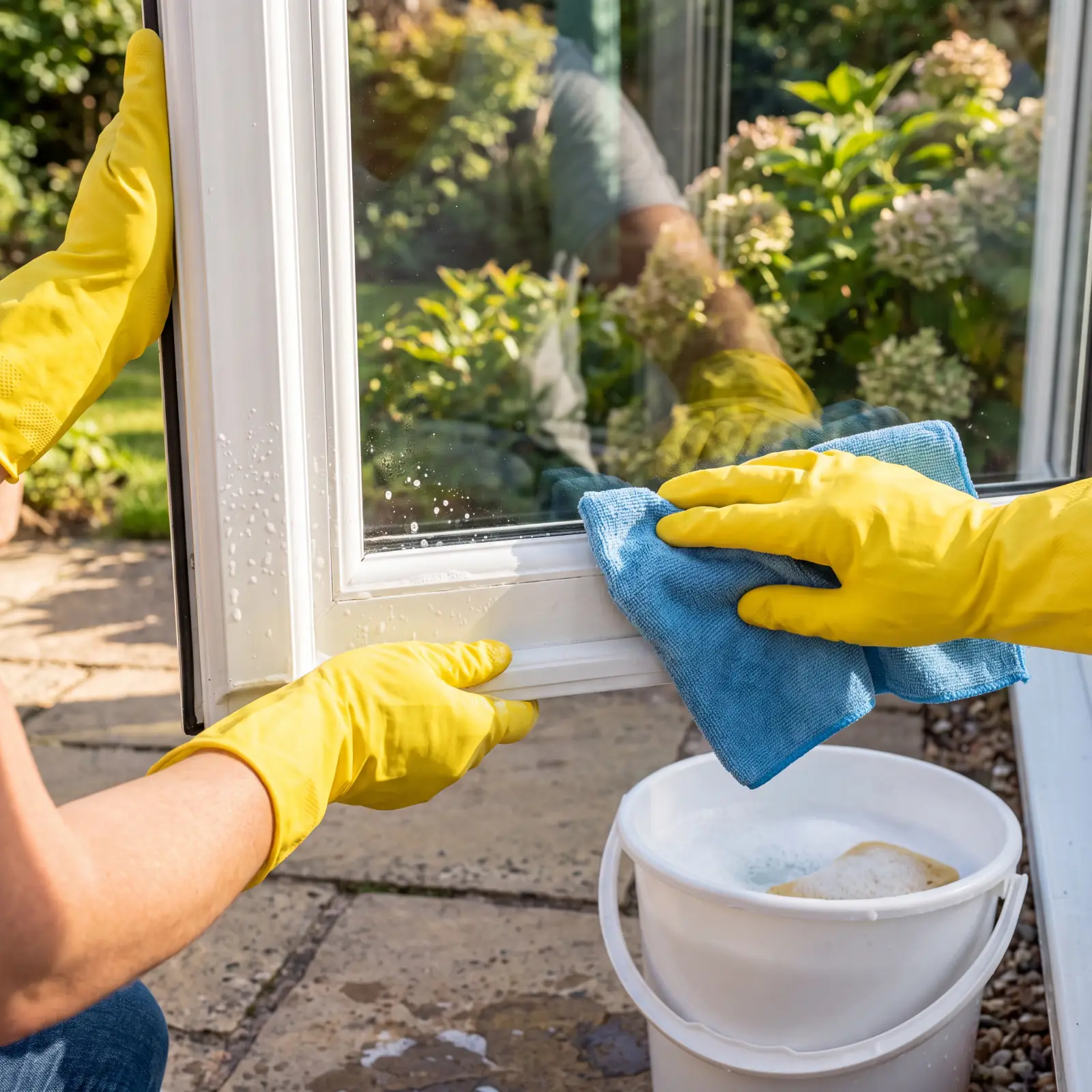
uPVC earned its dominance by being low-maintenance. Low was never none, though. The difference between a frame that looks tired at fifteen years and one that looks fresh at thirty is a twice-yearly routine that takes about twenty minutes across a window-heavy house. We see both kinds of frame every week, often on the same street. So here's the complete care guide: what works, what quietly wrecks frames, and the small habits that add years to hardware and seals.
Cleaning frames: the safe method
Warm water, a squeeze of washing-up liquid, a soft cloth or sponge. That's the entire approved chemistry for routine cleaning. Vacuum or brush the loose debris out of frames and tracks first, wash the uPVC, rinse, then dry with a microfibre cloth. White frames that have dulled respond to a dedicated uPVC cream cleaner, used sparingly and on white frames only. Test a hidden corner before you commit. Twice a year keeps frames genuinely white. Make it four times if you're near a main road, heavy industry or the sea.
The blacklist: what ruins uPVC
- Solvents and aggressive cleaners such as white spirit, acetone, cellulose thinners and oven cleaners. They soften the surface and dull it permanently.
- Abrasives including scouring pads, wire wool and gritty cream cleansers. They scratch a gloss that never comes back.
- Bleach, which yellows white frames with repeated use. The exact opposite of the goal.
- Cream cleaners on foiled or coloured frames. Woodgrain and coloured foils take soapy water only. Anything stronger risks the finish.
- Pressure washers, which force water past gaskets and into drainage chambers. A hose on gentle flow is the limit.
- Repainting. Standard paints don't bond to uPVC and fail badly. Professional respray systems exist, but DIY painting is how good frames become permanently shabby ones.
Glass, gaskets and the drainage slots nobody checks
Glass takes any standard glass cleaner, because the Low-E coating lives inside the sealed unit where no cloth can reach it. While you're there, wipe the rubber gaskets with soapy water and look for shrinkage or cracking. Perished gaskets are cheap to replace and expensive to ignore, since they're where draughts and leaks begin. Then comes the most neglected component on every window we survey: the drainage slots along the bottom of the outer frame. They exist to let rainwater out of the frame's internal channels. Once they're blocked with moss and grit, water pools inside the frame against the glazing unit, a quiet cause of premature misted units. Clear them with a thin plastic tool or a pipe cleaner every wash. Thirty seconds per window buys years of difference.
Hardware: the five-minute service that prevents call-outs
Twice a year, every moving part gets a moment. Silicone spray or light machine oil goes on hinges, locking points and the espagnolette strip. Cylinders take graphite or silicone, never household oil. Wipe the keeps, then check the handles lift smoothly with the sash open. Run the two diagnostic tests from our repair guides while you're at it. Does the handle operate sweetly with the door open? Do the gaps around closed sashes look even? Stiffness caught at the annoying stage is a simple adjustment. Stiffness ignored until the jammed stage is an emergency locksmith. The same routine covers composite doors too: soapy water on the slab, lubricated hardware, cleared thresholds.
The twice-yearly checklist, complete
- Brush debris from frames and tracks, wash the uPVC with soapy water, rinse and dry
- Clean the glass, then wipe and inspect gaskets for shrinkage or cracks
- Clear the drainage slots on every window and door
- Lubricate hinges, locks, handles and cylinders with silicone or graphite, never cooking or household oil
- Operate everything: handles, tilt functions, restrictors, door adjusters. Smooth is the standard
- Scan the sealant lines outside for cracks and gaps, and note anything for resealing before winter
- Put it in the diary: spring and autumn, twenty minutes, done
When maintenance finds a problem
Early detection is the routine's real payoff. A gasket starting to shrink, a unit showing its first mist, a handle developing resistance, a sealant line cracking. Caught at that stage, everything is a small repair, and our repair-first policy means that's exactly what we'll quote. What maintenance can't do is reverse genuine end-of-life. Brittle yellowed frames, cracked welds and chronic misting are the replacement signals that no amount of soapy water postpones. Between those two poles, a maintained window simply lasts longer, works better and costs less. It's the least glamorous truth in this entire series, and one of the most valuable.
Frequently asked questions
What is the best thing to clean uPVC window frames with?
Warm soapy water and a soft cloth, genuinely. For dulled white frames, a dedicated uPVC cream cleaner used sparingly. For foiled or coloured frames, soapy water only. Keep solvents, abrasives and bleach away from uPVC entirely.
How do I get my white uPVC windows white again?
Wash with soapy water first, then use a purpose-made uPVC cream cleaner on stubborn grime, testing a hidden spot beforehand. Frames yellowed by age or sun rather than dirt have degraded plastic, and no cleaner reverses that. It's a replacement conversation.
What should I lubricate uPVC windows with?
Silicone spray or light machine oil on hinges, locks and multi-point strips, and graphite or silicone lubricant in key cylinders. Never household or cooking oils, which gum up mechanisms and attract grit.
Why do my window frames have little slots at the bottom?
Drainage. They let rainwater escape the frame's internal channels. Keep them clear, because blocked slots pool water inside the frame, soaking seals and shortening sealed-unit life. A pipe cleaner every wash-day is the whole job.
Can you paint uPVC windows?
Not with standard paints, which fail badly on uPVC. Professional spray systems with proper preparation can recolour frames semi-permanently, but DIY painting reliably turns a tired frame into a ruined one. A colour craving is usually better spent towards replacement.
How often should uPVC windows be maintained?
Twice a year, spring and autumn, covering cleaning, drainage, gaskets and lubrication in about twenty minutes for a typical house. Roadside, coastal and industrial locations benefit from quarterly washing.
Maintenance found something?
Gaskets, hinges, misted units, dropped doors. Our repair team fixes the small stuff across Greater Manchester before it turns into big stuff, and when a window really is done, the replacement gets made twenty minutes away in Trafford Park.
Call 07533 830717, WhatsApp us a photo for a fast quote, or request a free quote online.