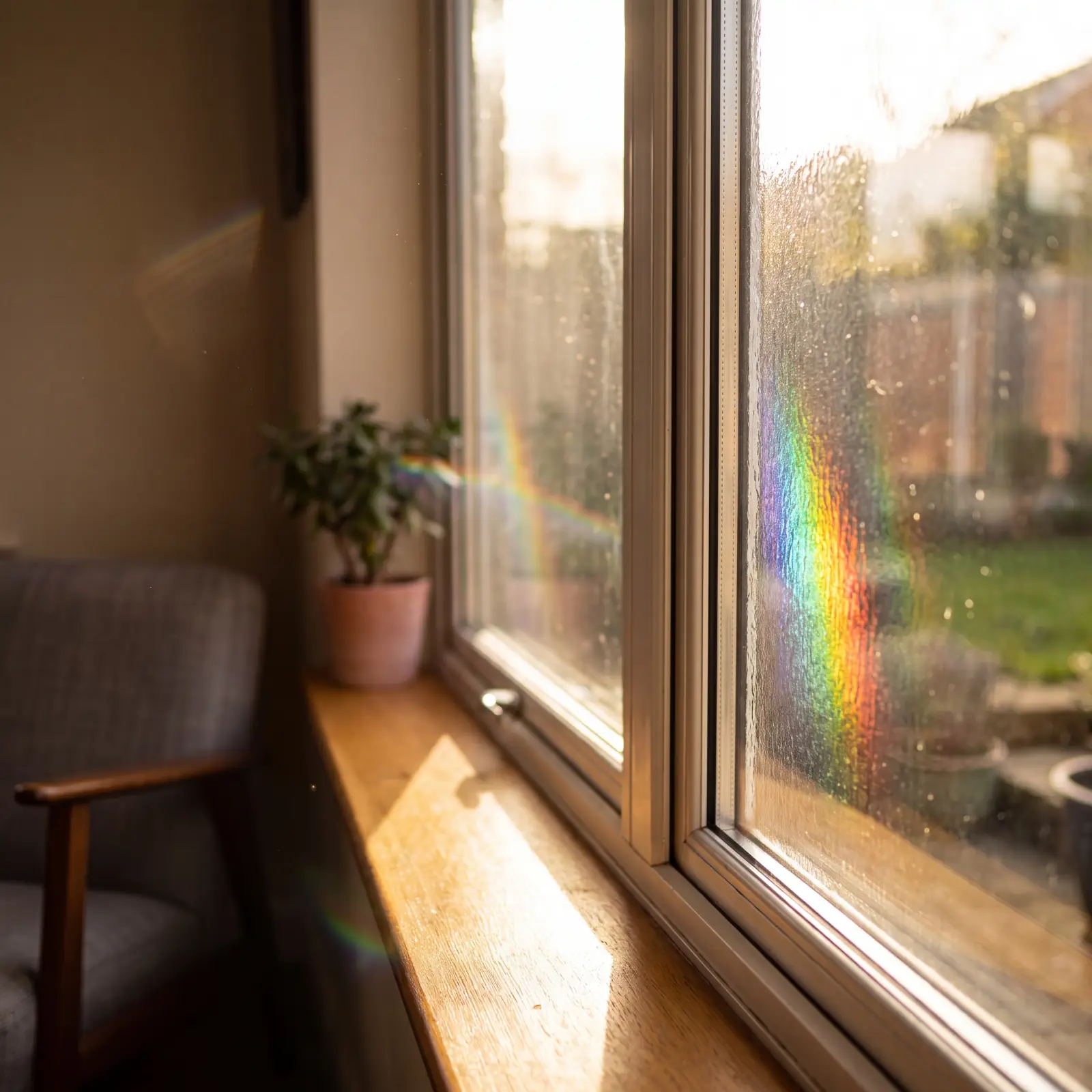
The most important component in a modern window is one you can't see. It's a metallic coating thinner than a soap bubble's wall, applied to one face of the glass, and it fundamentally changes how the window handles heat. Low-emissivity glass, Low-E for short, is the reason today's double glazing outperforms 1990s double glazing by such a margin. Understanding it takes about two minutes and one everyday analogy.
The thermos-flask trick
A thermos keeps coffee hot with a silvered surface that reflects radiant heat back at its source, and Low-E glass does exactly the same thing for your living room. A warm room constantly radiates heat as invisible infrared, and plain glass simply lets it stream outward. A Low-E coating, built from microscopic layers of silver or tin oxide, reflects that infrared back into the room while staying transparent to visible light. Daylight passes in. Radiated warmth bounces back. That physics is why the inner pane of a modern unit feels noticeably less cold to the touch on a winter night. It's returning your heating to you instead of exporting it.
Hard coat, soft coat, and why you'll get soft
There are two ways to make it. Hard-coat, or pyrolytic, Low-E is baked into the glass surface during float production, which makes it durable but slightly less effective. Soft-coat, or sputtered, Low-E is applied in vacuum chambers afterwards, giving higher performance from a delicate layer, which is why it always sits sealed inside the cavity of a double-glazed unit where nothing can touch it. Virtually all quality UK residential units now use soft-coat on the cavity face of the inner pane. You'll never see or clean the coating. You'll only feel what it does.
The supporting cast: argon and warm edges
Low-E handles radiation, but heat also crosses the cavity by conduction and convection, and that's where the rest of the modern unit comes in. Argon gas, denser and less conductive than air, fills the cavity and slows heat crossing it. It's a pennies-cheap upgrade that should be standard on any quote you accept. Warm-edge spacers replace the old conductive aluminium bar around the unit's perimeter with composite materials, closing the thermal short-circuit that used to ring old windows with condensation halos. Put the three together, Low-E, argon and warm-edge, and a unit that would manage a U-value near 2.8 comes down to 1.2 or better. It's the same production line our factory tour walks through.
| Unit build | Typical centre-pane U-value |
|---|---|
| Plain double glazing, air fill (1990s) | ~2.8 |
| + Low-E coating | ~1.8 |
| + Argon fill | ~1.4 |
| + Warm-edge spacer (whole modern unit) | 1.0-1.2 |
| Triple glazed equivalent | 0.6-0.8 |
What Low-E means for you, practically
- Warmer inner glass, so you can sit by the window in January without a draught of chilled air rolling off it
- Dramatically less internal condensation, the cold-surface problem behind wet windows and mould largely disappears
- Heating bills cut in line with the U-value drop, the arithmetic is in our energy savings guide
- Slightly reduced light transmission (a few percent) and occasionally a faint haze at raking angles, the only real costs, and in practice unnoticed
- One quirk: external condensation on cold clear mornings, which is the coating proving the outer pane no longer leaks your heat
Variants worth knowing
Solar-control Low-E adds coatings tuned to reject summer sun while keeping winter performance, and it's the answer for big south- and west-facing glazing that overheats. It's a close relative of the technologies in our smart glass overview. Acoustic laminated panes combine happily with Low-E, and so do obscure and toughened glass, because the coating is a layer in the recipe rather than a constraint on it. Should a quote for new windows in 2026 arrive without Low-E as standard? Ask what else has been quietly left out.
Already got sound frames but 1990s glass? The whole modern recipe of Low-E, argon and warm-edge can go into your existing windows as replacement sealed units, manufactured in our Trafford Park glass shop, usually within the week. We reckon it's the cheapest 40% heat-loss reduction in home improvement.
How to check what glass you currently have
Two home tests tell you plenty. First the flame test. Hold a lighter or phone torch near the glass at night and study the reflections. You'll see one per glass surface, and in a Low-E unit one reflection carries a distinct colour tint, often faintly purple or green, where the coating sits. If all the reflections look identical, you're probably looking at plain uncoated glass. Then the touch test. On a cold evening with the heating on, press a palm to the inner pane. A modern Low-E unit feels merely cool, while old plain glazing feels distinctly cold and radiates chill. Add the spacer check between the panes, where shiny aluminium means old spec, and within a minute you'll know whether your glass is 1990s or current technology, and whether glass-only upgrades are worth pricing for your house.
Frequently asked questions
What does Low-E stand for and do?
Low emissivity. The glass carries an invisible metallic coating that reflects radiated room heat back inside instead of letting it escape, while passing daylight normally. It's the core technology behind modern efficient glazing.
Can you see or feel Low-E coating on glass?
In normal use, no. It's optically near-invisible and sealed inside the unit's cavity. Occasionally a faint haze or colour shift shows at sharp angles or in direct sun. That's the coating, and it's completely normal.
Is Low-E glass worth it?
It's less a question of worth it than of non-negotiable. The coating delivers the largest single share of a modern unit's insulation at minimal manufacturing cost, so any 2026 quote without it is describing an obsolete product.
Does Low-E glass make rooms darker?
Marginally, admitting a few percent less visible light than plain glass, which is imperceptible in practice. Solar-control variants tint slightly more by design, and that's exactly what overheating south-facing rooms want.
Why do my new windows have condensation on the outside?
Because the Low-E unit is doing its job. So little heat escapes that the outer pane stays cold, and dew forms on it on clear mornings before burning off with the day. It's a sign of quality, not a fault.
Can Low-E units go into my existing frames?
Usually, yes. If the frames are sound, modern Low-E argon units replace the old glass directly and transform performance for a fraction of full replacement cost. We manufacture and fit them across Greater Manchester.
Upgrade the glass, keep the frames
Modern Low-E, argon-filled, warm-edge units made in our Manchester glass shop, fitted into your existing sound frames or into new A++ windows, and covered by a 10-year guarantee either way.
Call 07533 830717, WhatsApp us a photo for a fast quote, or request a free quote online.