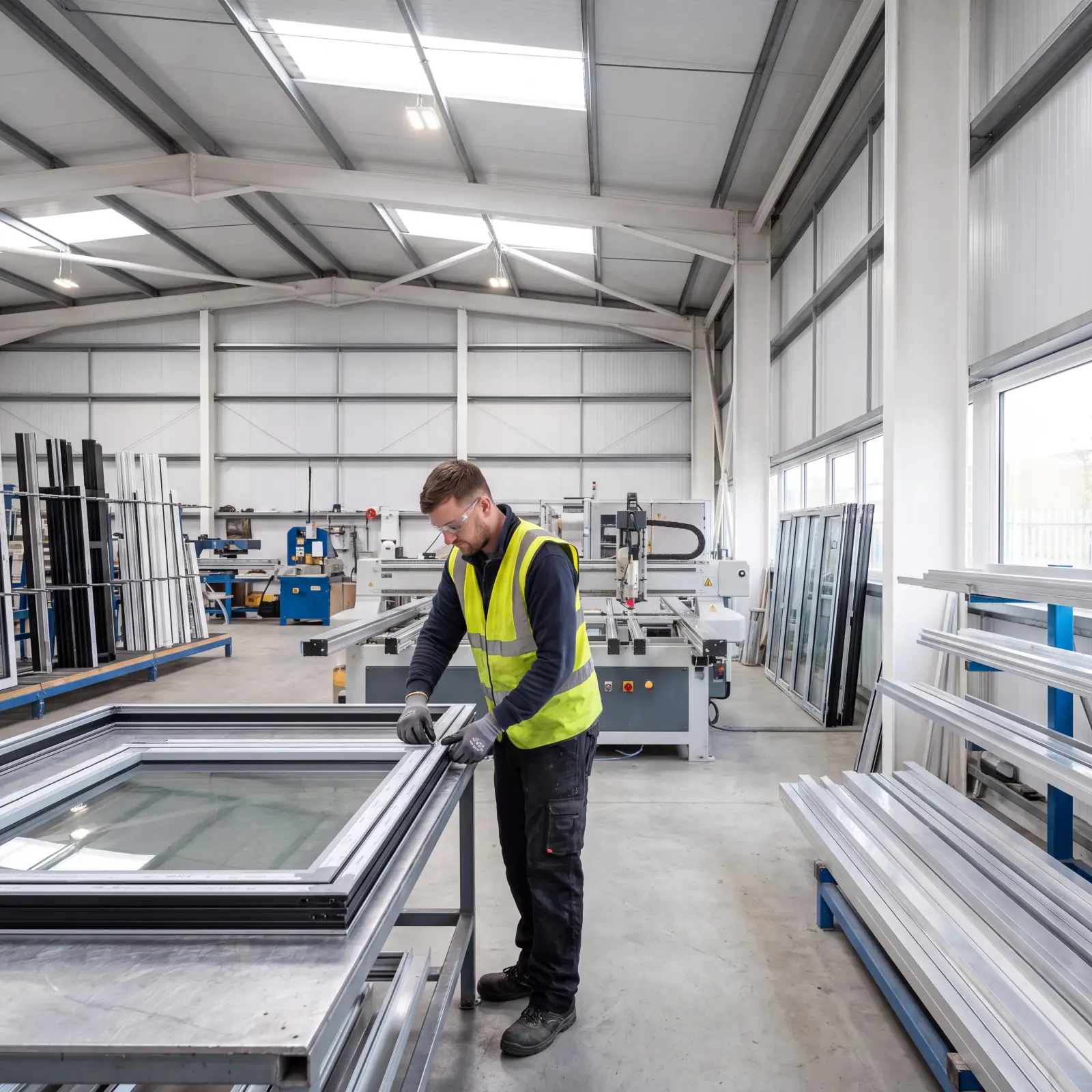
Most people buy windows without ever seeing one made. That suits some sellers nicely, because the differences between a good window and a cheap one are almost invisible from the showroom. Walk a fabrication floor and you can't miss them. They're in the reinforcement going, or not going, into the frames, in the spacer bars on the glass line, in the care taken over the corner cleaning.
So come and have a look. This is how a made-to-measure double glazed window comes together in our Trafford Park factory, stage by stage, along with what it should teach you about whatever window you end up buying.
Stage 1: Survey becomes cutting list
Every window starts life as a set of survey measurements. Brick-to-brick sizes, checked at three points because openings are never truly square, minus fitting tolerances. Software then converts each window's dimensions into an optimised cutting list, nesting every component across stock lengths of profile to keep waste down. A single house's order might mean forty unique components. Nothing here comes off a shelf.
Stage 2: Cutting and machining the profile
uPVC or aluminium profile arrives in six-metre lengths and goes through precision saws working to half-millimetre accuracy, cut at 45° for welded uPVC corners or square for mechanically joined aluminium. Machining centres then punch and rout the drainage slots that let rainwater escape the frame, the hardware preparations for locks and hinges, and the reinforcement fixings. Skipping the drainage routing is a classic cheap-window shortcut. Invisible on day one. A waterlogged frame by year five.
Stage 3: Reinforcement, the hidden difference
Quality uPVC frames carry galvanised steel or composite sections inside their main chambers, and that's what keeps a frame rigid over decades, so the seals stay compressed and the locks stay aligned. Aluminium needs none of it, because the strength is the metal itself, paired with a polyamide thermal break that stops it conducting heat. When you're comparing quotes, ask directly what reinforcement is in the frame. It's a one-question quality test, and it flusters low-cost suppliers every time.
Stage 4: Welding and joining
uPVC corners are heat-welded, fused at around 250°C into a joint stronger than the profile itself, then corner-cleaned by machine for crisp lines. Aluminium corners are mechanically crimped around cleats with sealant, a joint engineered to cope with the metal's expansion. A tidy, consistent corner is the fabricator's signature. Ragged corner cleaning on a sample tells you plenty about everything you can't see.
Stage 5: The sealed glass unit
Meanwhile the glass line is building the double glazed unit. Two panes, usually one of them Low-E coated, separated by a warm-edge spacer bar filled with moisture-absorbing desiccant, gas-filled with argon for insulation, then sealed twice over with a primary seal on the spacer and a deep secondary seal around the perimeter. That double seal is what keeps the unit clear for decades. When it eventually fails you get the fogging we cover in our misted glazing guide. Making units in-house is also why our glass replacement service turns failed units around in days.
Stage 6: Hardware, glazing and quality control
Frames then get their multi-point locks, friction hinges and handles, the full PAS 24 security package, before the sealed units are glazed in with internal beads so the glass can't be removed from outside, and packered precisely so the sash weight sits correctly and never drops. Finally, every window is cycled, measured and checked against its order before wrapping. Good factories are boring at this stage. Boring means nothing surprising reaches your house.
Why buying from the factory matters
- No middle margin, the fabricator's price is the price, with no salesman's commission stacked on top
- Weeks, not months, no import lead times, and remakes or adjustments happen locally
- Specification control, reinforcement, glass, spacers and hardware are our choices to stand behind, with a 10-year guarantee
- Trade welcome, builders and installers buy direct from our counter for exactly the same reasons
- One accountable company from survey to installation across Greater Manchester
The questions this should arm you to ask
You now know more about window construction than most of the people selling them, so use it on your next quote. Ask what reinforcement sits inside the uPVC frame, and whether the aluminium is genuinely thermally broken. Ask whether the sealed units use warm-edge spacers and argon fill, and who actually manufactures them. Ask whether the glazing beads are internal. Ask where the frames are made, because 'British company' and 'made in Britain' are very different claims. And ask what happens if a unit fails in year six. Is the guarantee held by the people who built the window, or by a sales office that may not exist by then? A quality fabricator answers all five without blinking, while a box-shifter changes the subject to this month's discount. The gap between those answers is the gap between windows that perform for thirty years and windows that become someone else's cautionary tale.
Frequently asked questions
How long does it take to manufacture a window?
A made-to-measure window spends roughly a day moving through cutting, machining, welding, glazing and QC, but factories run orders in batches, so survey-to-delivery is typically 2-3 weeks for uPVC and a little longer for powder-coated aluminium.
What's inside a uPVC window frame?
Multiple hollow chambers for insulation, steel or composite reinforcement in the main chambers, drainage channels at the base, and gaskets at every glass and sash junction. Chamber count and reinforcement are what separate quality frames from budget ones.
What is the gas between double glazing panes?
Usually argon, which is denser than air and slows heat transfer across the cavity. Krypton does better still in slim cavities. The gas seeps out slowly over decades, which is one reason sealed units have a finite life.
What's a warm-edge spacer and does it matter?
It's the bar separating the panes at the edge of a sealed unit. Old aluminium spacers conducted heat and caused condensation halos around the glass edge, and warm-edge composites cut that heat bridge significantly. A small component well worth insisting on.
Can I visit the factory before ordering?
Yes. We're in Trafford Park, and trade and retail customers are welcome to watch production and handle profile samples. Ten minutes with the real components beats any brochure.
Are factory-direct windows actually cheaper?
Typically 20-30% against national sales-led brands for equivalent or better specification. The saving is the commission and marketing layer, not the window, and you gain a direct line to the people who made your frames.
Come and watch your windows being made
We manufacture uPVC and aluminium windows in Trafford Park and fit them across Greater Manchester and Cheshire. Visit the factory, get your hands on the profiles, and walk away with a factory-direct quote and a 10-year guarantee.
Call 07533 830717, WhatsApp us a photo for a fast quote, or request a free quote online.