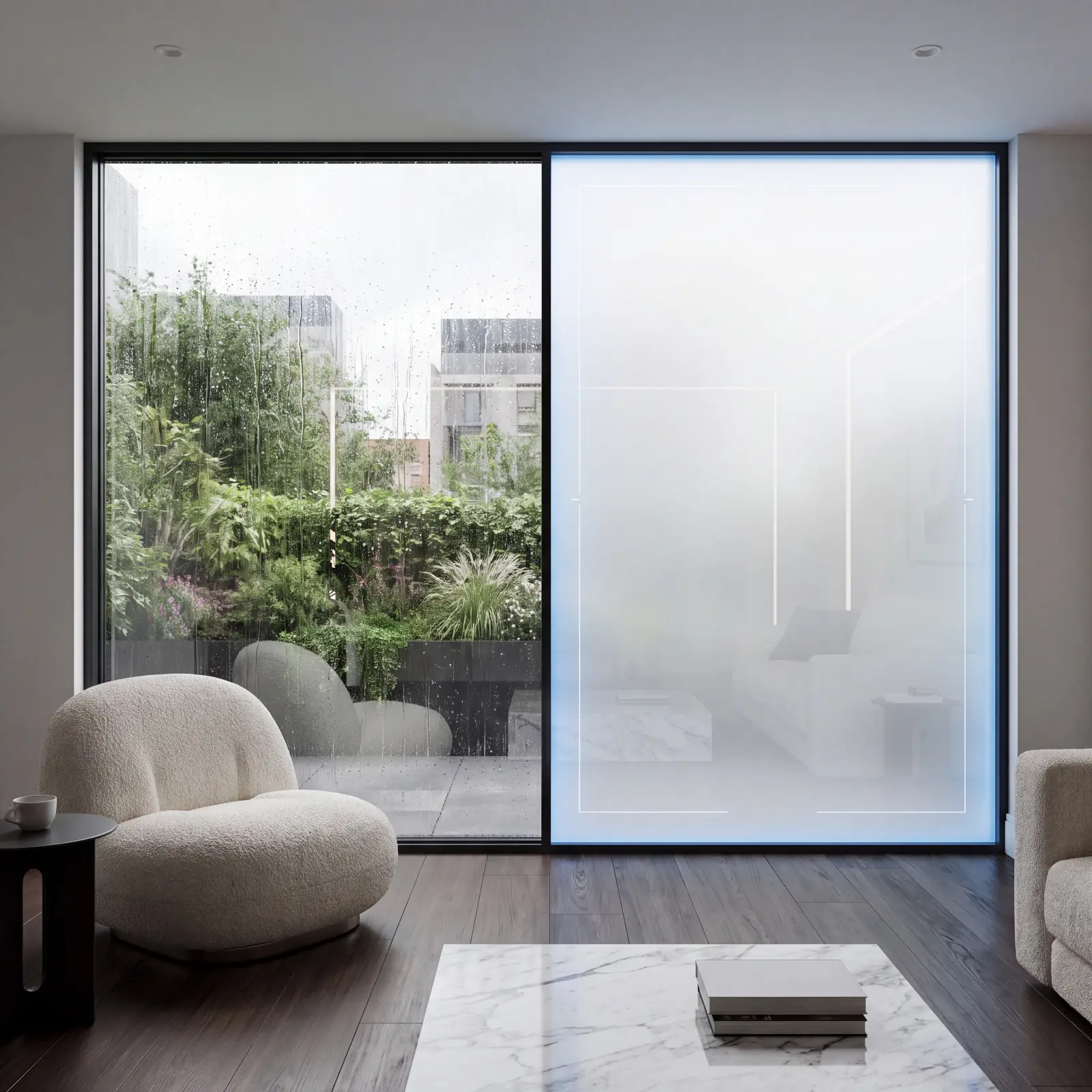
For a century, a window was a fixed thing. Glass in a frame, the same on a July afternoon as on a January night. That era is ending. Glass that tints itself against summer sun, flicks from clear to private at the tap of a phone, and reports its own performance is migrating from commercial towers into ordinary homes, and the factories making windows are changing just as fast under automation and AI.
We watch this space professionally, because a Manchester fabricator that doesn't will get left behind. So let's separate what's real today from what's coming, and both from what's still just marketing.
Switchable privacy glass: here now
PDLC (polymer dispersed liquid crystal) glass contains a film that scrambles light when unpowered and aligns transparent when a small current runs through it. The result is glass that switches between frosted and clear instantly, from a wall switch or an app. It's been common in office partitions and upscale bathrooms for years, and prices have now fallen far enough that we see it turning up in residential en-suites, street-facing home offices and internal screens. Think of it as a blind you can never break, built into the pane itself.
Electrochromic glass: the self-tinting window
Electrochromic coatings tint gradually, like transition sunglasses you can control, cutting glare and solar heat gain on demand while keeping the view. Airlines fit it instead of window blinds. Premium commercial buildings use it instead of external shading. For a heavily glazed south-facing extension it solves the overheating problem that otherwise demands blinds or brise soleil. It's still a premium product, but the cost curve is heading the same way solar panels went.
The quieter revolutions already in your window
- Low-E coatings reflect heat back into the room through invisible metallic layers. Yesterday's sci-fi, fitted as standard today; our Low-E explainer covers how they work.
- Solar-control glass rejects summer heat while letting the light through, which matters more each year as UK summers warm.
- Vacuum glazing delivers triple-glazing performance in a unit as thin as single glass. A genuine breakthrough for heritage windows with shallow rebates.
- Integrated blinds sealed between the panes never gather dust or tangle, and they're already popular in doors.
- Sensors and smart-home hooks such as contact and climate sensors built into the hardware, feeding alarms and heating systems.
AI on the factory floor
The bigger near-term change is one customers never see. Modern fabrication now runs on automated cutting and machining centres that optimise every length of profile to minimise waste, on cameras and software that inspect welds and sealed units with a consistency no human shift can match, and on production scheduling that threads hundreds of unique made-to-measure frames through a factory without error. AI-driven quoting is arriving too. Photograph your openings, get an accurate specification and price back in minutes.
For customers this is practical rather than futuristic. Tighter tolerances, fewer defects, faster lead times, less material waste, and all of it shows up as better windows at better prices. It's the direction we're investing in at our Trafford Park factory, where made-to-measure already turns around in weeks rather than months. See how a modern window is actually made.
What's worth buying today vs waiting for
| Technology | Status 2026 | Verdict |
|---|---|---|
| Low-E, argon, warm-edge | Mature, standard | Non-negotiable on any new window |
| Solar-control glass | Mature | Specify on south/west glazing now |
| Integrated blinds | Mature | Buy if you want them |
| PDLC privacy glass | Established, premium | Buy for the right room |
| Electrochromic tinting | Early residential | Wait unless budget is generous |
| Vacuum glazing | Emerging | Watch, ideal for heritage |
The sensible strategy for a 2026 buyer
Windows last 25-40 years, so buy the mature technology at its best. That means A++ rated, thermally efficient and PAS 24 secure, in a design that doesn't block future upgrades. Sealed units can be swapped within a sound frame, so a quality frame bought today will happily accept tomorrow's cleverer glass. Which is also the strongest argument against cheap frames: they'll be in landfill before the interesting glass gets affordable. Planning a project and want the current options explained without the hype? Talk to us. We fit what's proven, and we'll tell you straight what isn't yet.
How to spot smart-glass marketing nonsense
A market this exciting attracts exaggeration, so keep three filters handy. First, ask whether the 'smart' feature is in the glass or just an app-controlled accessory. An integrated blind with a motor is useful, but it isn't smart glass and shouldn't be priced like it. Second, ask for the specification in numbers, meaning switching speed, power draw and the warranty on the switching layer, since the film is the component that ages and reputable suppliers warrant it separately. Third, be sceptical of whole-house smart glazing proposals. Even commercial projects use switchable glass selectively, on the panes where privacy or glare control actually earns the cost. A supplier who suggests one clever pane in the bathroom and ordinary A++ glazing everywhere else is probably the one telling you the truth.
The window industry moves slowly, then all at once. Double glazing itself went from luxury to legal minimum inside a generation, and smart glass is walking the same road. For now, the sensible money buys the best conventional performance available, in a frame worthy of tomorrow's upgrades.
Frequently asked questions
What is smart glass and how much does it cost?
Usually it means PDLC switchable privacy glass, which is clear when powered and frosted when off. Expect roughly £350-£700 per square metre supplied, several times the cost of ordinary glazing, which is why it tends to go on one or two feature panes rather than whole houses.
Can smart glass replace curtains and blinds?
For privacy, yes, instantly and permanently. For blackout, no. Frosted PDLC still transmits light, and electrochromic tinting handles glare and heat without fully blacking out either. Bedrooms usually still want a blind.
Is self-tinting glass available for homes?
Yes, electrochromic units can be specified residentially, but at heart they remain a premium commercial product. For most homes, solar-control coatings deliver most of the benefit at a fraction of the price.
Will today's windows become obsolete?
The frames won't. A quality frame is a 30-40 year platform, and new glass technologies arrive as sealed units that can be retrofitted into it. Buy the best frame you can and let the glass evolve.
How is AI changing window manufacturing?
Automated cutting, machine-vision quality control and intelligent scheduling are making made-to-measure faster, more accurate and less wasteful. Customers experience it as tighter tolerances, fewer defects and shorter lead times rather than as a feature on the window itself.
Does smart glass work in a power cut?
PDLC glass defaults to frosted without power, so you're private but not clear. Electrochromic glass holds its last state. Neither affects weather performance, because the intelligence is a layer on top of ordinary sealed-unit construction.
Want tomorrow-proof windows without the hype?
We'll specify the proven technology for you. A++ glazing, solar control where it genuinely earns its keep, and smart options only where they fit, all manufactured in Manchester with a 10-year guarantee.
Call 07533 830717, WhatsApp us a photo for a fast quote, or request a free quote online.