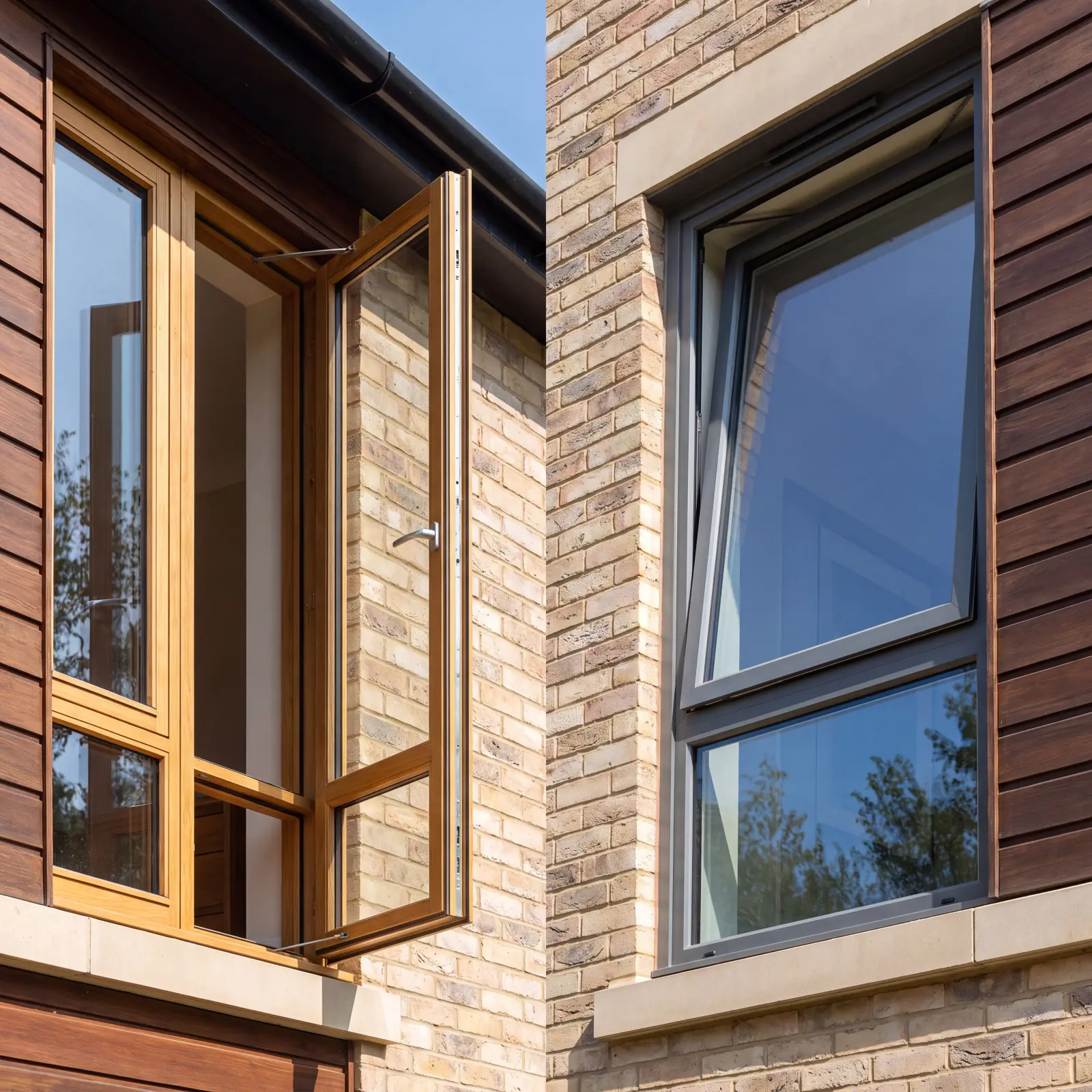
Walk down any British street and you're looking at casements. The side-hinged window that swings outward like a little door has been the national default for a century. Cross the Channel and everything opens the other way, tilting inward from the top or swinging in like a gate. That's the tilt and turn. Both styles are made to measure in the same materials with the same glass, so choosing between them comes down to how each behaves in the rooms of your actual house. We make and fit both every week, and this is how we'd talk it through with you.
How each style works
Casements hinge at the side, or at the top for awning-style openers, and swing outward on friction stays, worked by a simple handle. Familiar, uncomplicated, and proven against British weather. Tilt and turns do two jobs from one handle. Turn it one way and the sash tilts inward from the top for secure ventilation. Turn it further and the whole sash swings inward like a door. The mechanism is more complex, and it earns its keep by doing more.
Ventilation: two different philosophies
A fully open casement catches a passing breeze better than any tilt ever will, and modern hardware gives you a night-vent position for a locked crack of airflow. Tilt and turns take the opposite approach. The tilted position gives draught-free, rain-resistant, secure background ventilation you can leave running overnight or while you're out at work, which changes life in bedrooms and in any house that battles condensation. Put simply, casements move more air on demand. Tilt and turns move enough air, safely, all the time.
Cleaning and access: the tilt and turn party trick
Swing a tilt and turn fully inward and you can wash the outside pane from inside the room. No ladder. No leaning out. No waiting for the window cleaner's round. For upper floors, flats, and anything above a conservatory or extension, this one feature sells the style on its own. The full-turn opening is also large enough to serve as a compliant escape route, and it makes passing furniture through the opening far easier. A casement above ground level, by contrast, only gets cleaned if someone can reach it.
The practical trade-offs
| Factor | Casement | Tilt & turn |
|---|---|---|
| Opening direction | Outward, clears the room | Inward, needs clear space |
| Blinds & curtains | Unaffected | Must clear the tilting sash |
| Max sash size | Modest, stays limit weight | Large, hardware carries more |
| Ventilation security | Night-vent latch | Locked tilt position, excellent |
| Cleaning from inside | No (upper floors need access) | Yes, full inward swing |
| Cost | Base price | Typically +15-25% |
| Street look | Traditional British | Contemporary/European |
Which rooms suit which style
- Living rooms and kitchens: casements. The familiar look, big airflow when you want it, and no fight with a windowsill full of plants and photos.
- Bedrooms: this is where tilt and turns earn their premium. Secure overnight ventilation, easy cleaning, and generous escape openings.
- Upper floors and flats: tilt and turn, for the inside-cleaning alone. Plenty of apartment specifications insist on it.
- Bathrooms: either, with obscure glass. The tilt position's rain-proof airflow quietly earns its keep against steam.
- Street-facing period elevations: casements, or heritage sliders. Tilt-and-turn frames read continental and a touch chunky against traditional brickwork.
Security and performance
Both styles achieve PAS 24 certification with multi-point locking, and both take identical glass, whether that's A++, acoustic or solar control. Two small distinctions, though. A tilted tilt and turn is an engineered, locked position you can happily leave unattended, while a casement on its night-vent latch offers more modest security. And the inward compression seals of a tilt and turn give it a slight edge on seriously exposed sites. Neither point should overrule the room-by-room logic above.
Mixing casements and tilt and turns
Nothing says you have to pick one style for the whole house. The specification we quote most often for Manchester family homes runs casements across the street-facing elevation, where looks and resale value matter, with tilt and turns in the rear bedrooms and anywhere above the extension, where ventilation and cleaning matter more. Made to measure in the same profile and colour, the mix is invisible from outside and better to live with inside. That flexibility is the whole point of buying from a fabricator rather than a catalogue.
Rehearse the decision before you order
Both styles live or die by daily habit, so rehearse yours. Stand in each room and look around. What's on the windowsill, and would an inward-swinging sash sweep it onto the floor? Where do the blinds hang? Who cleans this window now, and how? Do you actually sleep with windows open, or just wish you safely could? Kitchen sink windows deserve extra thought, because reaching over a sink to work any handle is awkward, and easy-reach casement hardware and tilt-first arrangements each solve a different half of that problem. Ten minutes imagining an ordinary Tuesday in each room will choose better than any showroom visit, and it's exactly the walkthrough our surveyors do with you.
Frequently asked questions
What is the difference between casement and tilt and turn windows?
Casements hinge at the side and open outward. Tilt and turns open inward two ways from a single handle, tilting from the top for secure ventilation or swinging fully in for cleaning and escape. Same materials, same glass, different daily habits.
Are tilt and turn windows more expensive?
Usually 15-25% over an equivalent casement, which reflects the more complex hardware. Spend the premium where it works hardest, in bedrooms and on upper floors, where the ventilation and self-cleaning features pay off daily.
Are tilt and turn windows secure enough to leave open?
In the tilted position, yes. It's an engineered, locked configuration designed for exactly that, and a genuine step up from propping a casement. Full PAS 24 certification is available for both styles.
Can you fit blinds with tilt and turn windows?
Yes, with a little planning. Blinds and curtains need to clear the inward-tilting sash, so perfect-fit blinds mounted on the sash itself, or brackets standing clear, are the usual answers. It's the style's main domestic friction, so settle window dressings when you order.
Which is better for a period property?
Casements or vertical sliders, whose proportions belong on British streets. The tilt and turn's slightly heavier continental frame sits better on modern homes and rear elevations, which is why mixed specifications are so common.
Do tilt and turn windows count as fire escape windows?
The full-turn opening is usually comfortably compliant, one of the style's quiet advantages for bedrooms. As with any escape window, confirm the clear opening sizes and keyless internal operation when you specify.
Not sure which suits which room?
That's what a survey is for. We'll walk the house with you and spec casements, tilt and turns or a sensible mix, made to measure in our Manchester factory with A++ glass, PAS 24 locking and a 10-year guarantee.
Call 07533 830717, WhatsApp us a photo for a fast quote, or request a free quote online.