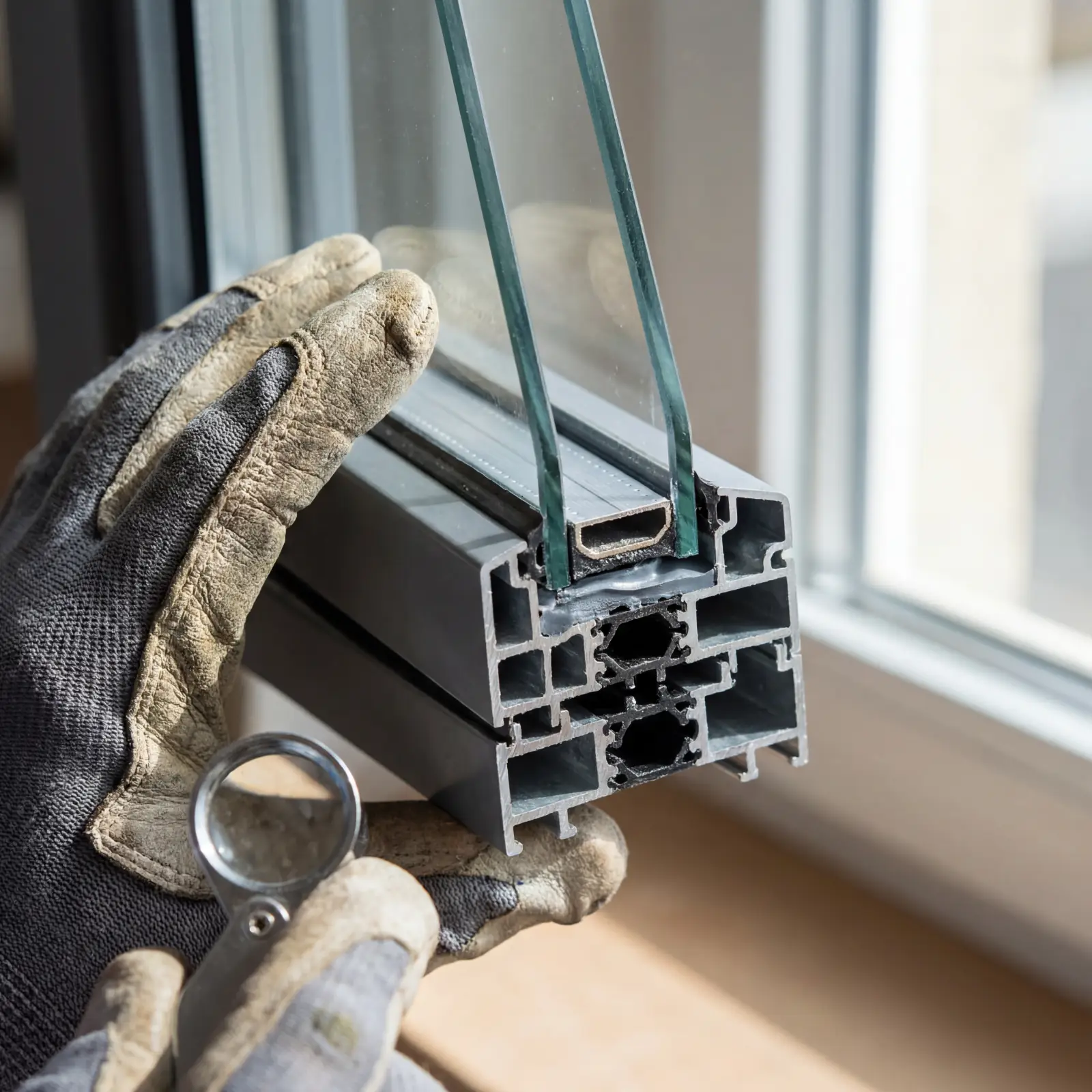
Stand a cheap window next to a quality one in a showroom and they look almost identical. That resemblance is the cheap window's entire business model. The real differences live in cross-sections, edge details and components with unglamorous names, and once you've learned to read those, you can assess any window in five minutes with nothing beyond your hands and a couple of questions.
What follows is the inspection routine we'd use if we were buying windows for our own houses.
Ask for the corner sample first
Every serious supplier keeps cut-through corner samples, and a refusal to produce one is a verdict in itself. Once you've got the sample in hand, look at three things. Wall thickness of the plastic, since Class A profile walls run about 2.8mm and economy profiles are visibly thinner. Chamber count, because a quality uPVC frame has five or more internal chambers where a budget one has three. And the big one, whether there's steel or composite reinforcement sitting in the main chamber. An empty chamber where reinforcement should be is the signature of a window built to a price.
Read the glass edge
Now look into the edge of the sealed unit, where the two panes meet the spacer bar. Shiny bare aluminium means cold-edge, an older technology that leaks heat and breeds condensation halos, while dark grey or black composite means warm-edge, the modern standard. Ask about gas fill too. Argon should be standard, and quality units carry a fill-check port or certification. Then ask if it's Low-E glass, and expect an immediate yes (our Low-E explainer covers why). The unit should also carry etched or printed certification marks. Anonymous glass is a red flag.
Work the hardware like you'll live with it
Open, close and lock the sample, then do it again. Quality hardware feels damped and certain. Budget gear feels loose, gritty or vague, and it's the part of any window that fails first. Count the locking points as you turn the handle, because multi-point locking with mushroom cams is the PAS 24 standard, and a single latch is a 1990s security level being sold in the present day. Check the beads holding the glass sit on the inside, since external beads can be popped from outside, and ask what brand the hinges are. Named hardware means replaceable hardware, years down the line.
Interrogate the numbers, not the adjectives
- Whole-window U-value for your sizes, in writing: 1.2 W/m²K or better. 'Energy efficient' without a number is decoration.
- WER band: A++ available as standard, not as an upsell, the labels are decoded in our ratings guide.
- PAS 24: certified, not 'built to the standard of', a phrase that means untested.
- Guarantee: who holds it, what it covers (units, hardware, gaskets, installation), and whether it's insurance-backed.
- Fabricator: name and address of the factory. Hesitation here explains everything else.
Judge the installation promise too
A perfect window fitted badly is a bad window, full stop. So ask how the frames get fixed, and listen for through-frame fixings into masonry rather than foam alone. Ask how perimeters are sealed, expecting expanding tape or properly tooled silicone over foam and never bare foam. Ask who actually does the work, employed fitters or per-job subcontractors, and what happens with snags, and who you'd call in year three. In our experience the suppliers who answer all that fluently are the ones whose installations we never get called out to rescue.
Five-minute showroom checklist
- Corner sample: wall thickness, 5+ chambers, reinforcement present
- Glass edge: warm-edge spacer, argon, Low-E, certification marks
- Hardware: multi-point lock, named brands, smooth damped action, internal beads
- Paper: written U-value, A++ WER, PAS 24 certificate, guarantee terms
- People: factory address, employed fitters, a price that survives a night's sleep
Score a supplier out of five and the decision usually makes itself. Prefer to skip the showroom theatre altogether? Visit our Trafford Park factory, handle the actual profiles we fabricate, and take a written specification home to hold up against anyone.
Already bought? The same checks work in reverse
If the windows were fitted before you owned the house, this checklist doubles as a diagnostic. Cold aluminium spacers and condensation halos explain chilly rooms and point to units worth upgrading one by one. A handle that turns without engaging multiple locking points tells you the security level you're really living with, and that's often fixable with hardware upgrades rather than new windows. Frames that flex when you press the mid-rail reveal missing reinforcement, which can't be retrofitted but should shape your replacement timing. Knowing what you have turns a vague sense that the windows aren't great into a specific, prioritised plan. It also stops you paying for whole new windows where a £90 cylinder or a £120 glass unit is the real fix.
Frequently asked questions
How can I tell good double glazing from bad?
Inspect a corner sample for wall thickness, chamber count and reinforcement, check the sealed unit for warm-edge spacers and Low-E glass, work the hardware, and demand the numbers in writing, meaning whole-window U-value, WER band and PAS 24. Quality is verifiable, so take the five minutes.
What is a warm-edge spacer and why does it matter?
It's the bar separating the panes at the unit's edge. Bare aluminium versions conduct heat straight out and cause condensation around the glass perimeter, while warm-edge composites cut that bridge. It's a cheap component that reliably signals overall build quality.
Does argon gas in double glazing really make a difference?
Yes. Argon is denser than air and slows heat transfer across the cavity, improving the unit's U-value meaningfully for pennies at manufacture. If it's missing from a modern quote, expect cost-cutting elsewhere too.
Are all uPVC profiles the same quality?
No. Profiles are classed by wall thickness and vary in chamber design and required reinforcement, so two white frames can differ enormously inside. The corner sample tells the truth in ten seconds.
What questions catch out poor window companies?
'What reinforcement is in this frame?', 'What's the whole-window U-value on my sizes?', 'Show me the PAS 24 certificate', and 'What's the factory address?' Fluent answers correlate with good windows. Deflection correlates with everything this article warns about.
Is showroom quality the same as what gets installed?
It should be, and you can make sure by having the written specification, covering profile system, glass spec and hardware, form part of your contract. Then any substitution is a breach rather than a surprise.
Run the checklist on us
Come to the factory, cut open our corners, work the hardware and take the written spec away with you. Windows that pass inspection are the only kind we know how to make, fabricated in Manchester and guaranteed for 10 years.
Call 07533 830717, WhatsApp us a photo for a fast quote, or request a free quote online.