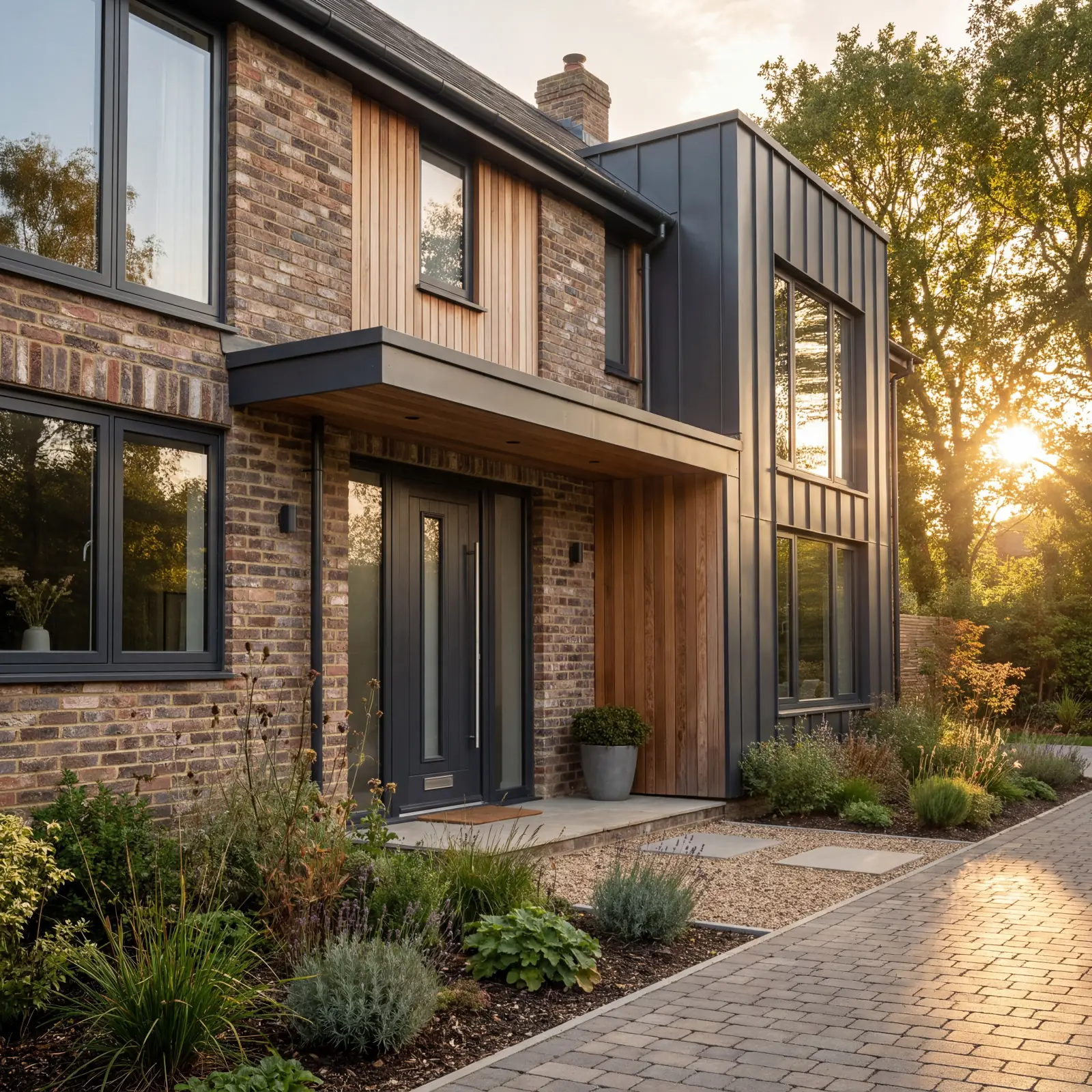
Windows move slowly as fashions go. A product that lasts 25 years tends to resist fads. But they do move, and 2026 finds the market mid-shift in several directions at once. Some of these trends will still look right in 2046 and deserve following. Others are worth understanding mainly so you can decline them politely. Watching it all from the order book of a Manchester factory, this is what's genuinely happening.
Colour: anthracite settles in, warmth arrives
Anthracite grey has completed its takeover. Roughly half of everything we fabricate now leaves in RAL 7016, and at this point it's earned classic status rather than fad status, because on render, modern brick and new-builds it simply works. The 2026 movement is happening at the edges. Black frames for confident contemporary schemes, and a fast-growing warm palette of bronzes, olive greens, creams and agate greys, led by heritage projects and by homeowners who see anthracite everywhere and fancy being different. Dual colour, one shade outside and white in, now makes up a third of our coloured orders. The street gets the statement while the rooms keep their light.
Style: flush casements become the new standard
The flush casement, its sash sitting level with the frame the way timber always did, has gone from premium niche to default aspiration. No wonder, because it flatters period and modern houses alike. Heritage looks are the strongest style current overall. Vertical sliders, cottage bars and conservation-friendly detailing keep coming through as Manchester's period streets swap their first generation of ill-fitting uPVC for something the architecture deserves. The premium end, meanwhile, is pulling the other way, towards slimline aluminium, bigger panes and corner glass. Look closely and both movements are really one trend. Windows chosen to suit the building rather than the brochure.
Performance: efficiency stops being optional
Energy prices managed what regulation never quite did, and buyers now open conversations with U-values. A++ specification is the practical baseline for 2026. Triple glazing is normalising on exposed elevations and northern aspects, and solar-control glass is the quiet climber as overheating joins heat loss on the worry list. A decade of glazed extensions has taught the region that summer comfort is a specification too. If you want the ratings decoded, our energy ratings guide does exactly that. The through-line is that performance talk has moved from the small print to the selling point.
Technology: useful first, clever second
The tech that's genuinely being adopted is unglamorous. Acoustic laminated glazing for road-facing bedrooms is our fastest-growing upgrade (see soundproof windows), integrated blinds in doors keep selling, and PAS 24 security hardware is now simply expected. Switchable smart glass is arriving one statement pane at a time, in bathrooms and home offices rather than whole houses, and sensor-ready hardware that talks to alarms is quietly becoming a checkbox. The pattern hasn't changed in years. Technology that removes a daily annoyance spreads. Technology that demonstrates well at parties waits.
What we'd actually advise for 2026
- Choose colour against your own brick and render using full-size samples. Anthracite is safe, warm tones are distinctive, black is a commitment
- Let the house pick the style: flush or heritage on character streets, clean casements or slimline aluminium on modern ones
- Specify A++ everywhere, and add triple or acoustic glazing only where the elevation earns it. Follow trends per pane, not per house
- Put trend money into permanent things like proportions and glass spec, and keep the experiments to hardware and accessories you can swap
- Be suspicious of any 'trend' that happens to match what a salesman has in stock this month
The trend behind the trends
Every current above points the same way. Away from the one-window-fits-all decades and towards houses specified individually, colour per street, glass per elevation, style per architecture. That's less a fashion than a correction, and it plays straight into made-to-measure fabrication. Whatever 2026 throws up next, windows chosen to fit the building have never gone out of style, and they're exactly what a local factory exists to make.
What Manchester's order books suggest the streets will look like in 2030
Project forward from what's being ordered today and the picture is fairly clear. Period districts increasingly restored with heritage-style sliders and flush casements in whites and warm tones. Post-war suburbs consolidating around greys, with composite doors as the colour accent. New-builds and premium renovations pushing glass area ever larger in slim, dark aluminium. Regulation will keep tightening on efficiency and ventilation, quietly turning today's A++ into tomorrow's minimum. And the houses that look best in 2030 will be the ones specified for their architecture rather than for the moment, which has been true in every decade since windows had fashions at all.
Frequently asked questions
What is the most popular window colour in 2026?
Anthracite grey is still the volume leader and has settled into classic status. Black is strong in contemporary schemes, and the warm tones, bronze, olive, cream, are the fastest risers. Dual-colour frames, coloured outside and white inside, are becoming standard practice.
Are flush casement windows worth the extra cost?
For kerb appeal, usually yes. The level, timber-like sightline flatters most houses, and flush has become the aspirational default. The premium over a standard casement is modest, and it's a style with decades of life left in it.
Is triple glazing becoming standard in the UK?
It's normalising rather than standard. Default in premium and exposed-site work, elevation by elevation elsewhere. A++ double glazing remains the value baseline for most Manchester homes, with triple specified where cold, noise or exposure justifies it.
Will anthracite grey windows date?
Every colour dates eventually, but fifteen years of sheer ubiquity have made anthracite the new neutral, closer to white's status than to a fad. If you want to stand apart from your street, the warm palette is where 2026's differentiation lives.
What window trends should I avoid?
Anything that fights your architecture, whether that's ultra-modern frames on period streets or applied cottage bars on plain modern houses, plus any technology bought for novelty rather than a daily problem. Be more cautious with trends in permanent elements than with trends in swappable hardware.
Do trendy windows add resale value?
Current, well-chosen windows do, because buyers read them as a modernised house. Suitability beats fashion, though. The premium comes from windows that look right on that particular building, which is why heritage styles outperform trend styles on period homes.
Are coloured windows more expensive than white?
Foiled or powder-coated colours typically add 10-20% over white, dual colour slightly more, and lead times can stretch a little for the less common RAL shades. Across a 25-year life the premium per year is small, so pick the colour you'll still like in a decade rather than the cheapest one.
See what 2026 looks like on your house
Full-size colour samples, style mock-ups worked up from a photo of your frontage, and straight advice on which trends actually suit your street. All from the Manchester factory fabricating every one of them, with a 10-year guarantee.
Call 07533 830717, WhatsApp us a photo for a fast quote, or request a free quote online.