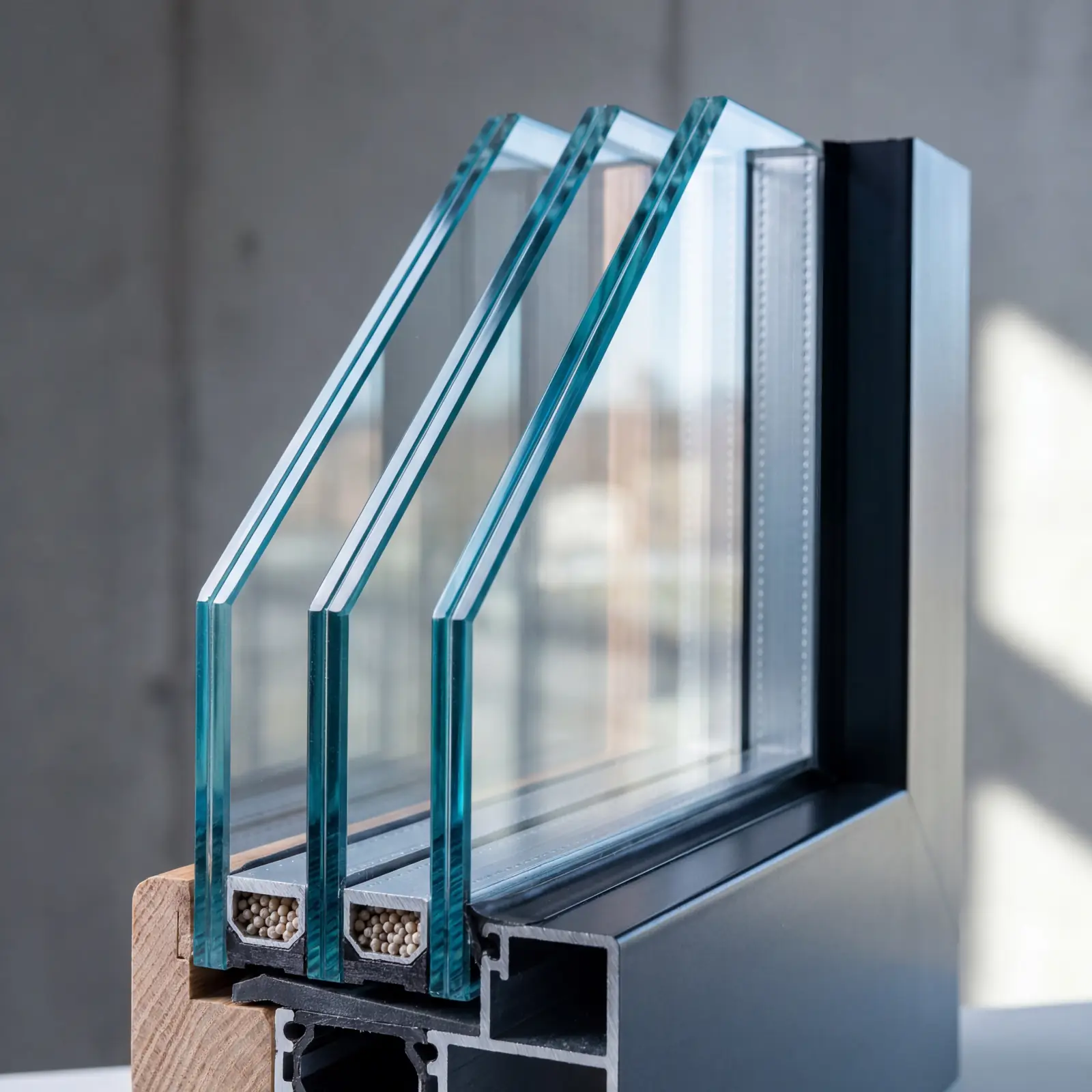
One number on a window quote does most of the work: the U-value. It tells you how fast heat escapes through the product, it's the figure building regulations actually police, and it's what sits underneath every 'energy efficient' claim in every brochure ever printed. Spend five minutes understanding it and you'll compare quotes better than plenty of people who sell windows for a living.
What a U-value measures
A U-value is heat flow. Specifically, the watts of energy passing through each square metre of the assembly for every degree of temperature difference between inside and out, written W/m²K. A window rated 1.2 leaks 1.2 watts per square metre per degree. Put real numbers on that and it gets vivid. On a 20-degree January difference, a 2m² window at U 1.2 loses around 48W continuously, roughly a dim lightbulb's worth, while the same window at 1980s-spec 3.0 loses 120W. Lower is better. The scale is linear. And unlike rating letters, it's directly comparable across every product and every manufacturer, which is exactly why we like it.
The reference points that matter
| Glazing/assembly | Typical U-value (W/m²K) |
|---|---|
| Single glazing | 4.8-5.8 |
| 1990s double glazing (air, no coating) | 2.8-3.2 |
| Building regs ceiling for replacements (2026) | 1.4 |
| Quality modern double (Low-E, argon, warm edge) | 1.0-1.2 |
| Triple glazing | 0.6-0.8 |
| Solid brick wall, for comparison | ~2.0 |
| Insulated cavity wall | ~0.3 |
Two rows deserve a second look. Single glazing leaks heat faster than a Victorian brick wall, which is why glazing upgrades transform period homes so dramatically. And even the best window loses several times more than an insulated wall. Windows are always the weak point in the envelope. That's not a reason to shrug, it's the reason their specification matters more than almost anything else you'll choose for the building.
Whole-window vs centre-pane: the quoting trick
The figure that counts is the whole-window U-value (Uw): glass, frame, spacer and edges combined, calculated for your actual sizes. Centre-pane values (Ug) measure the glass alone at its best point, run a flattering 0.2-0.4 better, and turn up in brochures for exactly that reason. Frames are usually the weak link, and small windows carry proportionally more frame, so the same specification produces different Uw figures at different sizes. Insist on whole-window numbers on the quote. A supplier who gives you centre-pane values without saying so has told you something useful about themselves. The components behind good numbers, Low-E coatings, argon and warm edges, and the rating letters built on top of them, each have their own guides.
What's actually worth paying for in 2026
- 1.4 is the legal ceiling for replacements. Treat it as the floor of acceptability, not a target
- 1.0-1.2 is the quality double-glazing standard and the value sweet spot for most Manchester homes. It's our A++ baseline
- Around 0.8 means triple glazing. Worth it on exposed elevations, north faces and noise-sensitive bedrooms; rarely a whole-house economic case
- Chasing below 0.8 belongs to Passivhaus projects, where the whole envelope justifies the spend
- Specifying per elevation beats one number everywhere. The weather-facing gable and the sheltered porch window don't need the same glass
Translating U-values to money
A rule of thumb for a gas-heated Manchester home: each 1.0 improvement in U-value across a typical house's ~16m² of glazing saves roughly 1,300-1,800 kWh a year, which is £90-£150 at 2026 prices. Moving from failed 1990s units (around 3.0) to quality modern glazing (around 1.1) therefore lands in the £180-£280 annual range before you count the draughts you've eliminated, and going from singles to modern is roughly double that. The full arithmetic, payback periods included, lives in our energy savings guide. The comfort arrives free with the number: warm inner glass, no condensation, and window seats you can actually use in winter.
The questions that make you a hard customer
Three questions, asked politely, sort every supplier we've ever come across. What's the whole-window U-value for my actual sizes? Is that certified or calculated, and can I see the documentation? What would it cost per window to improve it by 0.2? Fluent answers backed by paperwork mean you're dealing with people who engineer their product. Deflection towards rating letters and adjectives means the number wouldn't survive inspection. Every window we fabricate leaves the factory with its Uw stated in writing, because a number this important deserves at least that much.
One last piece of context before you spend anything. U-values compound with the rest of the envelope. A house with 270mm of loft insulation, filled cavities and 1.2 windows is nicely balanced; the same windows in an uninsulated solid-wall terrace are excellent components in a leaky system, and the loft top-up may be the better next pound. Fabric-first thinking, cheapest heat saved first, is the right way to frame every efficiency purchase, windows included. Glazing does jump the queue when it's failed, though. Misted, draughty units leak regardless of what the rest of the house is doing, and replacing them is maintenance and upgrade rolled into a single spend.
Frequently asked questions
What is a good U-value for windows in 2026?
For double glazing, 1.0-1.2 W/m²K whole-window is the quality standard. The regulatory maximum for replacements is 1.4, and triple glazing reaches 0.6-0.8. Lower is better, and the figure should be quoted for your actual window sizes.
What U-value do building regulations require?
Replacement windows in England must achieve 1.4 W/m²K or better (or WER band B+), with new-build standards tighter still. Any 2026 quote sitting at 1.4 is offering the legal minimum, which is worth knowing when you compare.
What's the difference between Ug and Uw values?
Ug is the glass alone at centre-pane, the flattering number. Uw is the whole window including frame and edges, the real one, and it's always 0.2-0.4 worse. Quotes should state Uw for your sizes. Brochures love Ug for a reason.
Is a lower U-value always worth paying for?
Up to the quality-double standard of 1.0-1.2, absolutely. Beyond that, returns diminish. Triple glazing's step to 0.8 pays on hard-weather elevations and for comfort, less so as a whole-house default. Spend per elevation, not per brochure.
How much does U-value affect heating bills?
Roughly £90-£150 a year per 1.0 of improvement across a typical house's glazing at 2026 gas prices. So moving from failed 1990s units to modern A++ is worth £180-£280 annually, before the draught-sealing gains that come with replacement.
Do doors have U-values too?
They do. Composite doors typically achieve 1.0-1.2, quality glazed doors 1.2-1.4, and the same whole-assembly logic applies. Ask for the doorset value rather than just the glass or slab figure.
Get your U-values in writing
Every quote from our Trafford Park factory states whole-window U-values for your actual sizes. A++ comes as standard, triple and acoustic options are priced per elevation, and the lot carries a 10-year guarantee.
Call 07533 830717, WhatsApp us a photo for a fast quote, or request a free quote online.