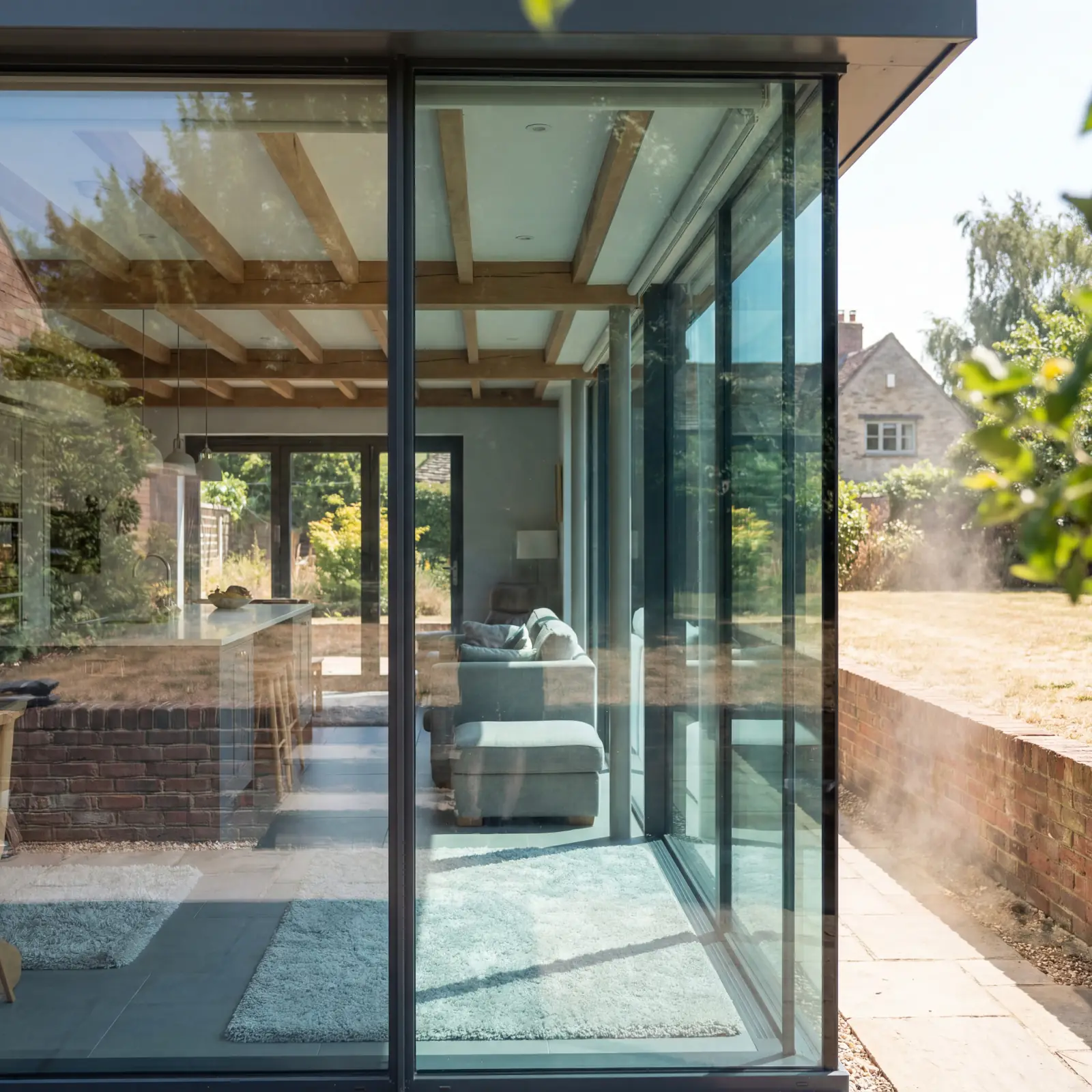
British glazing spent a hundred years fighting one enemy: the cold. Then July 2022 hit 40 degrees, heatwaves started showing up most summers, and thousands of lovely glazed extensions revealed their second life as greenhouses every August bank holiday. Overheating is now an official building problem, regulation and all, and windows sit right at the centre of it. So how do you keep a glazed room cool? And what does that change about how glass should be specified in 2026? Quite a lot, as it happens.
Why glazed rooms overheat
Sunlight passes straight through glass, hits your floor and furniture, and re-radiates as longer-wave heat that ordinary glazing traps. That's the greenhouse effect, running quietly in your kitchen extension. A south- or west-facing glass wall can let in several kilowatts of solar gain on a summer afternoon. Picture a couple of electric heaters running flat out in a room you're desperately trying to cool, because that's the equivalent. And modern homes make it worse, ironically. The airtightness and insulation that hold heat in through winter hold onto it just as stubbornly in July. Winter efficiency and summer comfort aren't the same problem, and solving one badly can make the other worse.
Part O: the regulation catching up
New homes in England have had to comply with Approved Document O since 2022. It's the overheating rulebook: limit unwanted solar gain, and provide a way to get excess heat out. In practice, designers now have to justify big glazed areas with proper mitigations. Solar-control glass. External shading. Cross-ventilation, and openable areas that can actually ventilate securely at night. It covers new dwellings rather than extensions to existing homes, but like every new-build standard, it shows where design expectations are heading, and heavily glazed extensions already get judged through the same lens. You can't spec a glass wall by area alone any more.
The window-side toolkit
- Solar-control glass: coatings that bounce a large share of the sun's heat away while letting most visible light through. Think g-values of 0.3-0.4 against roughly 0.6 for ordinary units. It's the single most effective upgrade for a hot room, invisible in use, and you can spec it pane by pane. Close cousin of the Low-E technology that looks after winter.
- Spec by orientation: high solar gain on north and east glass (free warmth in winter), solar control on south and west. Different elevations, different jobs. It's the per-elevation logic that runs through this whole series.
- Ventilation that's engineered, not hoped for: openings placed for cross-flow, plus tilt-and-turn or night-vent positions that stay secure overnight. Purging heat at 5am beats fighting it at 3pm.
- Shading built in: brise soleil, overhangs, integral blinds between the panes. Stopping the sun before it reaches the glass always beats blocking it afterwards.
- Honesty about glass area: sometimes the right answer is slightly less glass, better placed. That's a hard sentence for a glazing company to type. It's still true.
Fixing the extension you already have
You don't need to demolish the hot room. Sealed units are replaceable, so existing bifolds, sliders and roof lights can be reglazed with solar-control units in the frames they're already in. That's usually the cheapest intervention that actually works, and it's done in a day. Add secure night ventilation (a hardware upgrade often does it) and some shading on the worst elevation, and the greenhouse turns back into a garden room. We retrofit exactly this package across Greater Manchester's extension belt every summer, through the same glass replacement service that deals with misted units.
The specification conversation to insist on
Anyone quoting big glass in 2026 should be able to answer three questions. What's the g-value on each elevation, and why? How does this room dump heat overnight without leaving a window invitingly open? And what happens in the August worst case, modelled rather than guessed? Suppliers who are fluent in those answers are designing for the climate you'll actually live in. Suppliers who only talk U-values are selling last decade's problem. The best glazing now does both jobs at once, warm in January and temperate in July, and the components to manage it are sitting on the shelf. What separates the comfortable houses from the complained-about ones is specification, not technology.
This problem only grows from here, too. UK climate projections point to more frequent, longer heatwaves through the 2030s, glazed extensions are still the nation's favourite improvement, and homes designed only for winter are ageing into a two-season headache. The houses that'll feel best in 2035 are being specified right now, by people who asked about the g-value alongside the U-value. Two numbers, one comfortable home. It's probably the cheapest piece of climate adaptation most households will ever buy.
Frequently asked questions
Why does my extension get so hot in summer?
Big areas of glass let in kilowatts of solar heat that ordinary glazing then traps, which is the greenhouse effect in action, and modern airtight construction keeps all that warmth inside. South- or west-facing glass with no solar control and no night ventilation is the classic recipe.
What is Part O of building regulations?
It's the set of overheating rules for new homes in England, in force since 2022. Designs have to limit unwanted solar gain and provide a way to remove excess heat, whether that's solar-control glazing, shading, a ventilation strategy or simply less glass. Extensions aren't formally covered, but they're increasingly designed to the same logic.
What is solar control glass and does it work?
It's glass with a coating that reflects much of the sun's heat while letting most of the light through, with g-values around 0.3-0.4 against 0.6 for ordinary units. It noticeably tames hot rooms, looks like normal glass, and can be fitted as replacement units into your existing frames.
Can I fix an overheating room without replacing the doors?
Usually, yes. Reglaze the existing frames with solar-control units, add secure night-vent hardware, and shade the worst elevation. That package costs a fraction of new doors and transforms August.
Does solar control glass make rooms dark or cold in winter?
No. Light transmission stays high, so rooms stay bright with barely any visible tint. You do give up some free winter solar gain, which is why it belongs on the hot elevations specifically rather than the whole house.
Is air conditioning a better answer than glazing?
AC treats the symptom and charges you forever for the privilege. Solar control and ventilation remove the cause, free of charge once installed. UK guidance and Part O both put passive measures first, and a room that needs less cooling makes any future AC smaller and cheaper anyway.
Love the glass, not the greenhouse?
We'll survey the hot room, spec solar-control glass elevation by elevation, sort secure night ventilation and reglaze your existing frames where we can. Manchester-made units, fitted in a day, with a 10-year guarantee.
Call 07533 830717, WhatsApp us a photo for a fast quote, or request a free quote online.